

Key Takeaways
- The 90-Day Window is Real: A new homeowner typically selects their local service providers (HVAC, pest control, dental) within 90 days of moving in. Campaigns that arrive after this window see response rates drop dramatically.
- Freshness Determines ROI: The single biggest factor in new homeowner marketing is list freshness. A list sourced from deed records within 14 days of filing will outperform a 60-day-old list, regardless of creative or offer.
- Source Matters: Not all new homeowner lists are equal. Deed transfer records confirm ownership, while USPS NCOA data includes renters. Understand your list’s primary source to ensure you’re reaching actual homeowners.
- Filter by Vertical: A generic list of all new buyers in a ZIP code is inefficient. Filter by home value for high-ticket services, household composition for family-focused practices, and dwelling type for contractors to improve relevance and reduce waste.
- Start with Direct Mail: For most local businesses, direct mail is the most reliable primary channel for reaching new homeowners. Use digital channels like geo-targeted ads as an amplification layer, not a starting point.
A new homeowner typically selects their HVAC company, pest control provider, insurance agent, and landscaper within the first 60 to 90 days of moving in. After that window closes, response rates to unsolicited outreach drop sharply not because the household stops spending, but because they have already committed to their vendors.
The difference between a 3% response rate and a 0.5% response rate on a new homeowner mailer is usually not the offer or the creative. It is whether the list reached the household inside that critical decision window. Campaigns that fail here typically use stale data, mailing to households that have already found their go-to providers.
This is a practitioner’s guide to getting the timing right. We will walk through how to build a new homeowner list that is fresh enough, filtered tightly enough for your vertical, and deployed through the right channel to land inside that window of opportunity.
Why New Homeowners Spend More and Why That Matters for List Selection
A household that has just closed on a property faces a compressed decision cycle across 10 to 15 service categories simultaneously pest control, landscaping, HVAC maintenance, insurance, furniture, window coverings, and new dental and medical providers. Unlike established homeowners who might replace vendors one at a time over several years, new homeowners are making first-time selections in nearly every category within a few months.
This is why new homeowner marketing is such a high-value exercise. New homeowners spend anywhere from 5 to 10 times more than established homeowners in their first year, according to various industry studies. But the number itself is less important than the mechanism behind it: category urgency and a lack of incumbent vendors. A household that closed last week needs a landscaper, window coverings, and a local dentist all at once. An established homeowner might replace one of those providers every few years.
This compressed buying window means the value of a new homeowner record is not static; it decays on a curve. A record that is 10 days old is worth significantly more than one that is 90 days old, because the household is still actively seeking providers. A record that is 120 days old represents a household that has likely already locked in most of its preferred vendors. This makes new homeowner marketing fundamentally a freshness problem, not a volume problem.
The 90-Day Brand-Loyalty Window and Why So Many Campaigns Miss It
The single most important variable in new homeowner marketing is timing. Most campaigns underperform not because of a bad offer or the wrong channel, but because the list reached the household after their brand-loyalty window had already closed.
This is a function of list decay. A new homeowner record loses its outreach value on a curve, not a cliff. In the first 10–14 days, the household is actively searching for providers. By day 30, many high-frequency categories like pest control and landscaping are often locked in. By day 60, most remaining core services have been decided. After 90 days, for outreach purposes, the household behaves more like an established homeowner.
How List Freshness Determines Response Rates
List freshness is the primary driver of response rate variance more so than the offer, creative, or channel. Consider two identical pest control postcards mailed to the same ZIP code. One reaches households within 10 days of their closing date; the other arrives 75 days after. The first mailer lands while the household is still searching for providers. The second arrives after they have already signed an annual contract with a competitor.
As a general rule, targeted direct mail campaigns for new homeowners can see response rates in the 1–3% range when the list is fresh (within 30 days of the move date). On records older than 60 days, that rate often drops below 0.5%. These are general industry ranges, not guaranteed outcomes, but the directional logic is sound. Freshness is not a nice-to-have; it is the variable that determines whether the campaign math works at all.
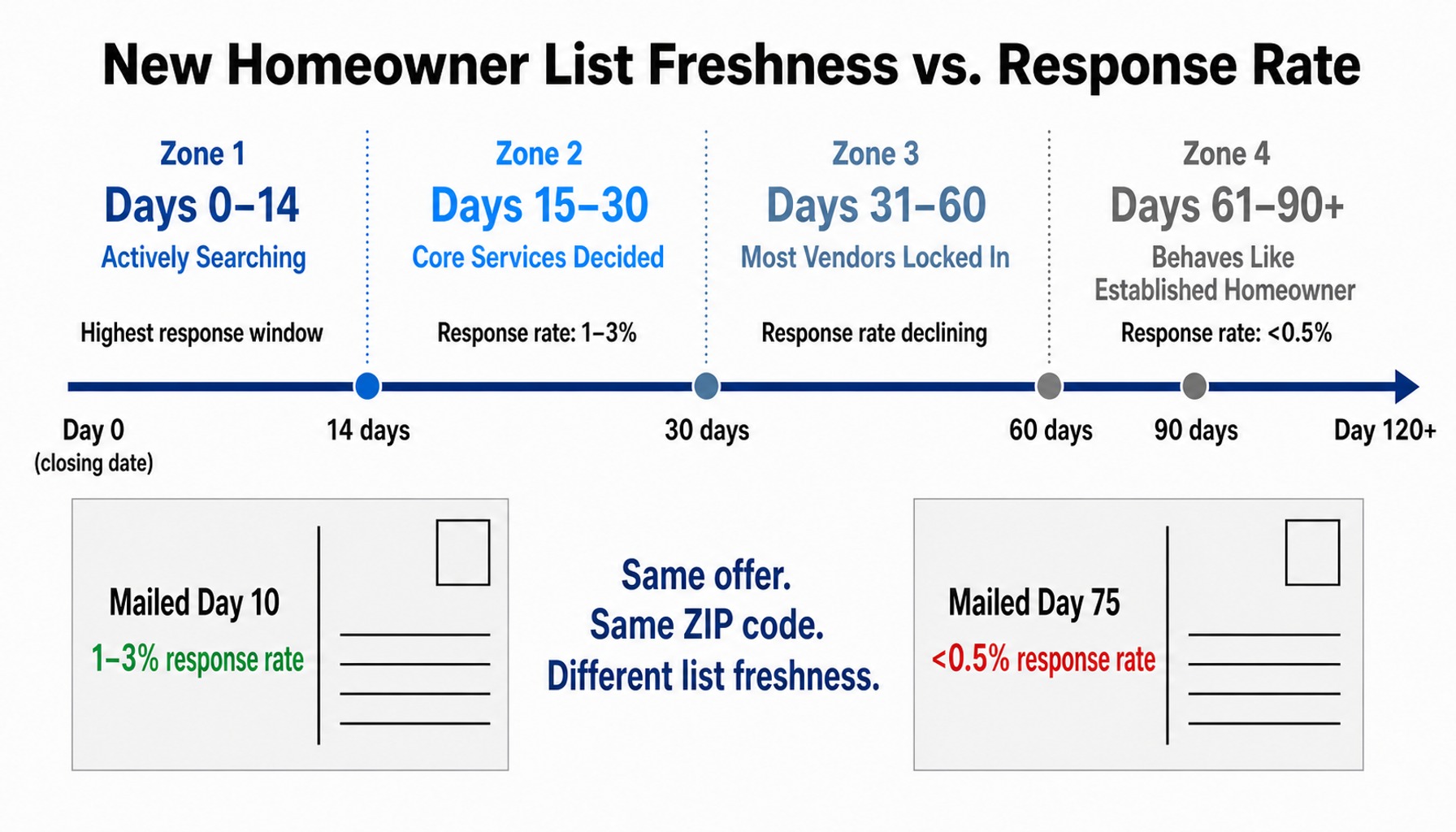
List freshness drives new homeowner marketing ROI more than creative or offer.
Pre-Mover vs. Post-Mover Targeting: Which to Use and When
There is a critical distinction most marketers miss: pre-mover versus post-mover targeting. Pre-mover lists use data like pending sales or mortgage originations to reach households before they move. Post-mover lists use deed transfer records or address changes to reach them after.
The trade-off is simple: pre-mover data gets your brand in front of the household earlier, but it is less certain. Transactions can fall through. Post-mover data is confirmed, but the clock is already ticking. Campaigns that try to merge these two distinct audiences into a single sequence tend to underperform, because the timing and messaging needs are completely different.
For most local service businesses HVAC, plumbing, dental post-mover data sourced within 7–14 days of the deed filing is the best balance of confirmation and speed. Pre-mover targeting is better suited to categories with longer decision cycles where the household is planning ahead, such as moving companies, mortgage refinancing, or home warranty providers.
Where New Homeowner Data Comes From and Why It Matters for Your List
Most marketers treat new homeowner lists as interchangeable commodities. They compare price per thousand and record count without asking where the records come from or how they were verified. This is a mistake. The data source determines the list’s freshness, its accuracy, and whether it includes renters or only confirmed owner-occupants.
The best lists often combine multiple sources, but understanding the two primary families is key to evaluating quality.
Deed Transfer Records and Property Filing Data
Deed transfer records, filed with county recorder offices when a property sale closes, are the most reliable source for confirmed new homeowner data. They verify that a transaction occurred, identify the buyer, and include the property address, sale date, and often the sale price. This is the gold standard for confirming owner-occupancy.
The trade-off is in the timing and aggregation. Because deed records are filed at the county level, national coverage requires compiling data from thousands of individual offices. The filing speed varies some counties post data online within days, while others can take weeks. Major compiled-list providers like InfoFree, ATTOM Data Solutions, and CoreLogic build their databases from these primary filings, and their value lies in how quickly and accurately they can ingest and standardize this disparate data.
NCOA, Utility Connections, and Supplemental Sources
The second family of sources is supplemental. The USPS National Change of Address (NCOA) file captures when a household files a forwarding request. Utility connection records capture new service activations. Both are useful but have limitations.
NCOA data, for instance, does not distinguish between homeowners and renters; it simply tracks anyone who files a change of address. In fact, because the filing often happens before the move, NCOA data is frequently a pre-mover signal that marketers mistakenly treat as a post-mover confirmation. Utility data is a stronger signal of occupancy but can include temporary or seasonal connections.
The strongest new homeowner lists use deed records as the primary source of truth for ownership and then append NCOA or utility data to fill gaps in counties with slow filing timelines. Some providers also use mortgage origination data or new construction permits to identify homeowners who may not appear in deed filings for months. The key question to ask any list provider is: what is your primary source, and how do you filter out renters?
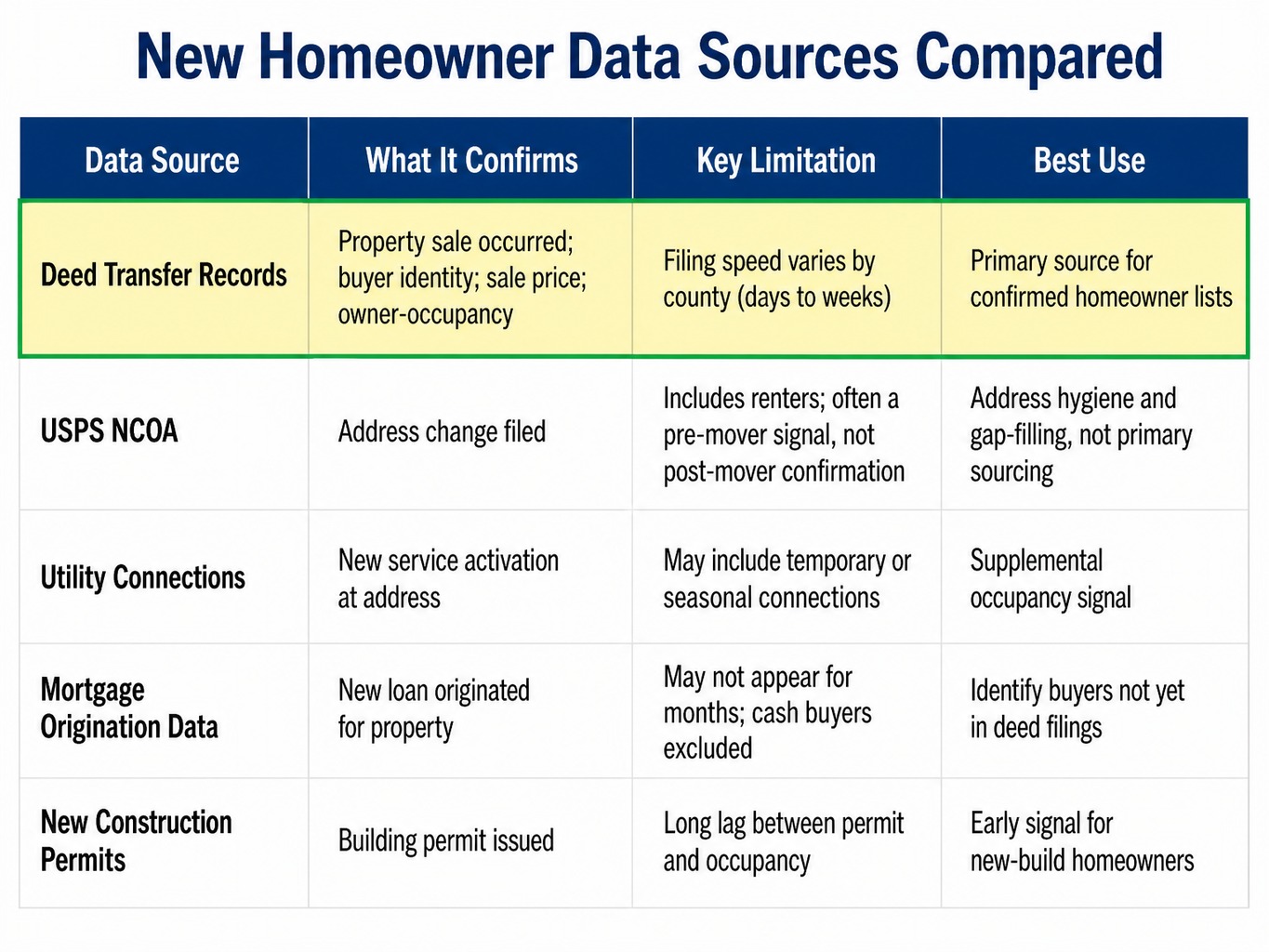
Not all new homeowner mailing list sources confirm ownership, so it is important to know the difference.
How to Build a New Homeowner List by Vertical
A generic new homeowner list every recent buyer in a ZIP code is a starting point, not a campaign. The verticals that see the highest ROI are those that layer additional filters on top of recency: estimated home value, dwelling type, household income, age of head of household, and geography down to the carrier route.
The same underlying data supports vastly different campaigns. The difference is which fields you prioritize based on your ideal customer profile.
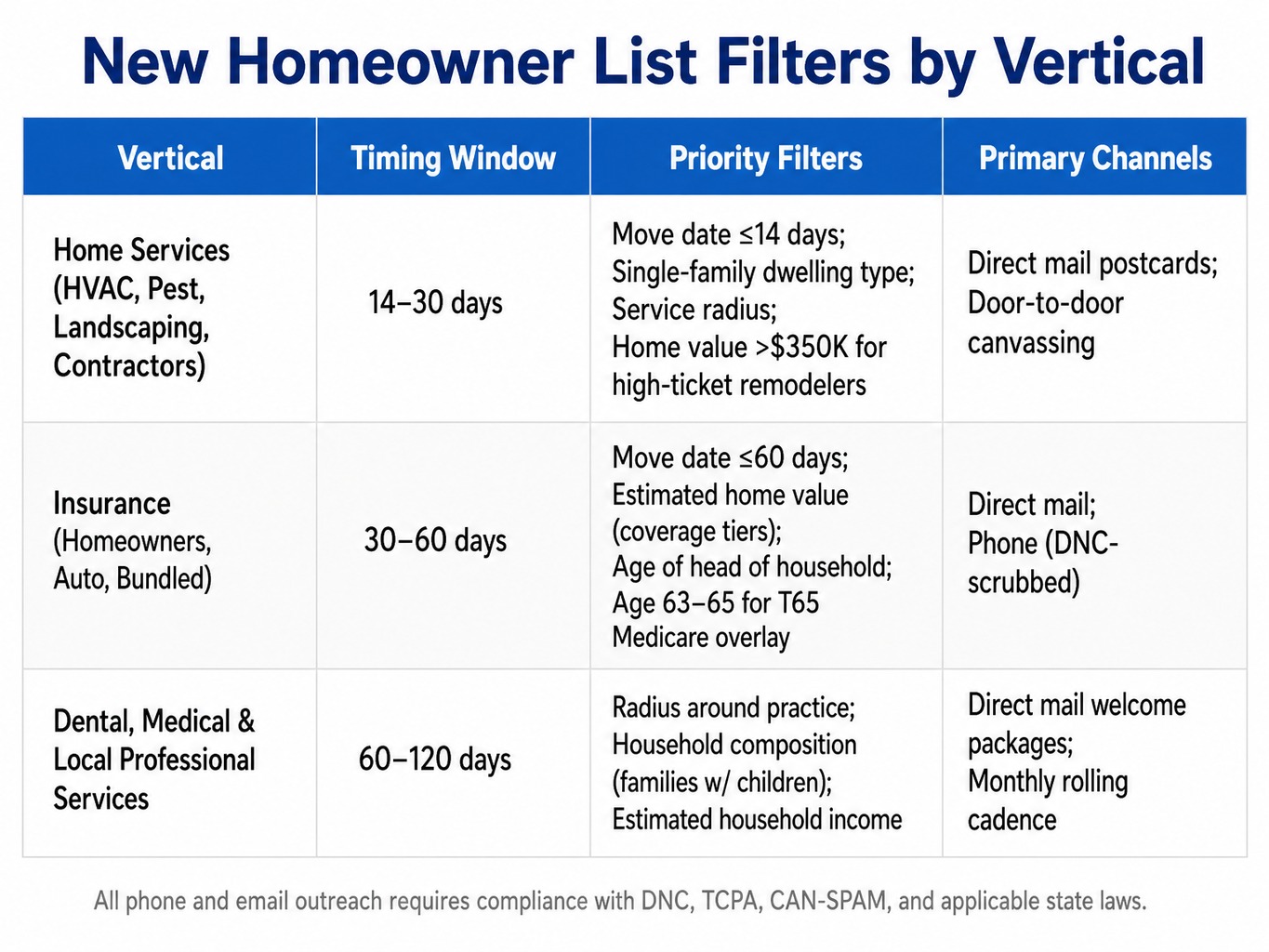
Marketing to new homeowners works best when filters match your vertical’s decision timeline.
Home Services: HVAC, Pest Control, Landscaping, and Contractors
Home services companies live and die by speed. These are the categories new homeowners decide on first, often within 14–30 days.
- Filters: Move date within the last 14 days; dwelling type (single-family homes, to exclude condos with HOA-managed services); geography within your service radius.
- Advanced Filters: For high-ticket contractor and remodeler campaigns, layer in estimated home value above a threshold that matches your typical project size. A kitchen remodeler targeting $50K+ projects should filter for homes with an estimated value above $350,000.
- Channels: Direct mail postcards and door-to-door canvassing are highly effective. The household is physically present and making decisions about the property. Any phone or email outreach requires the marketer to comply with DNC, TCPA, CAN-SPAM, and applicable state privacy laws.
Insurance: Homeowners, Auto, and Bundled Policies
Insurance agent campaigns have a slightly longer window than home services. New homeowners often have a policy assigned at closing by their lender but will shop for better rates within the first 60–90 days. For verticals like insurance where the first provider to reach a new homeowner often locks in a multi-year relationship, the difference between a list refreshed biweekly and one refreshed monthly can represent tens of thousands of dollars in lifetime customer value lost per campaign cycle to slower data.
- Filters: Move date within the last 30–60 days; estimated home value (to align with coverage tiers); age of head of household.
- Advanced Filters: For agents targeting seniors, layer age 63–65 on top of new homeowner status to find households where a T65 Medicare conversation is also relevant.
- Channels: Direct mail and phone outreach are primary. Agents must scrub against the National Do Not Call Registry and comply with all TCPA and state telemarketing laws before calling.
Dental, Medical, and Local Professional Services
Local professionals like dentists, pediatricians, veterinarians, and CPAs have a wider timing window of 60–120 days. These are not urgent first-week decisions, but new homeowners do select new providers within the first few months.
- Filters: Geography (radius around the practice); household composition (e.g., families with children for a pediatric or family dental practice); estimated household income if the practice serves a specific market segment.
- Channels: Direct mail “welcome packages” a postcard with a new-patient offer and the practice address are the standard. Consistency is key; mailing monthly to the latest batch of new homeowners produces steadier patient acquisition than one-time blasts.
Channels That Work for New Homeowner Outreach and Honest Trade-Offs
Channel selection for new homeowner campaigns depends on two variables: your vertical’s decision timeline and the data fields available on your list.
- Direct Mail: This is the workhorse. It has the highest reach, requires no prior opt-in, and lands directly in the hands of a household actively looking for local services. The trade-off is cost; CPM (cost per thousand) can run $400–$600+ for a printed and mailed postcard campaign. It is the best primary channel for home services, insurance, and local professionals.
- Phone: Phone outreach can have high conversion rates, but it requires a valid phone number on the record and strict compliance with the National DNC Registry, TCPA, and state laws. It works best for considered purchases like insurance or financial services where a conversation is needed.
- Email: Email is the lowest-cost channel per touch but has two hurdles: not all new homeowner lists include a verified email address, and all outreach is subject to CAN-SPAM regulations. It is best used as a follow-up channel after an initial mail piece has been sent.
- Digital Ads: Using platforms like Google Performance Max or Facebook to geo-target ads can be a useful reinforcement layer. Services like USPS Informed Delivery can even add a digital ad impression to your physical mail piece. However, targeting new homeowners specifically through ad platforms alone is difficult without uploading a list as a custom audience.
For most local businesses, a simple rule applies: direct mail is the primary acquisition channel, and digital is the amplification layer not the other way around. Regardless of channel, the marketer is always responsible for ensuring their outreach is compliant with all applicable laws.
Read more: New Mover Lists – Email and Mailing Lead Lists from Infofree
How to Source and Filter New Homeowner Records in One Platform
Effective new homeowner marketing requires fresh records sourced from deed filings, filtered by vertical-specific fields, and acted on quickly. Most marketers are stuck between buying static, per-record lists from brokers or trying to stitch together multiple data sources manually.
InfoFree’s consumer and household database offers a more direct workflow. It references approximately 270 million U.S. consumers and 170 million households, including new homeowner and new mover records compiled in-house from property and public-record sources.
The process mirrors the strategy outlined in this guide. You can search by geography (ZIP code, county, or radius), then apply filters for:
- Homeowner Status & Move Date
- Estimated Home Value & Dwelling Type
- Age, Estimated Income & Household Composition
You build the list, refine the count, and then either export the records for your campaign or push them into the built-in CRM101 for follow-up. InfoFree’s subscription includes unlimited search and view, with export limits that vary by plan, allowing you to test filter combinations and model audience sizes before committing your export credits.
It is important to note that these consumer and household records are compiled from a separate set of sources than our triple-verified business database and are not rated on the same 95% accuracy standard that applies to B2B data. When using any exported data, customers are responsible for following all applicable local, state, and federal laws, including DNC, TCPA, CAN-SPAM, and state privacy statutes. InfoFree provides the data; it is not liable for how customers use it.
Search new homeowner records by ZIP, home value, and move date start with a free trial to test your filters before you export.
Conclusion
If there is one belief to change, it is this: new homeowner marketing is a timing and data-quality problem, not a creative or channel problem. The households that spend the most are reachable for the shortest window. This means a campaign’s ROI is determined upstream by how fresh the list is, how tightly it is filtered, and whether it reaches the household before they have committed to competitors.
If your current new homeowner campaign is mailing to records older than 30 days, or if you don’t know the primary source of your data, the list is the first thing to fix. Fix that before you redesign the postcard, test a new offer, or experiment with another channel.
Frequently Asked Questions
How do I avoid sending new homeowner mailers to renters?
Use a list sourced from deed transfer records rather than NCOA data alone. Deed records confirm a property sale and identify the buyer, while NCOA tracks any address change including renters. Ask your list provider if records are filtered to owner-occupied residential properties before you buy.
How often should I refresh my new homeowner list?
For high-frequency verticals like pest control or landscaping, refresh weekly or bi-weekly to stay inside the 14–30 day response window. For longer-cycle verticals like insurance or dental, monthly refreshes are usually sufficient. A static list purchased once and reused for months will always underperform a rolling feed.
What response rate should I expect from a new homeowner direct mail campaign?
Response rates vary by list freshness, vertical, and offer, but targeted new homeowner postcards mailed within 14–30 days of the move date typically see 1–3% on initial contact. Records older than 60 days often drop below 0.5%. These are general industry ranges, not guaranteed outcomes.
Is USPS NCOA data enough to build a new homeowner list, or do I need a third-party provider?
NCOA data captures address changes but does not confirm property ownership it includes renters, temporary moves, and forwarding orders. For a list of confirmed new homeowners, you need a provider that sources from deed transfer records and filters to owner-occupied sales. NCOA is for address hygiene, not primary sourcing.
Can I get phone numbers and email addresses on a new homeowner list?
Phone numbers and emails are not always included in the base new homeowner record, which is sourced from property filings. Many providers append this data from consumer databases. Expect match rates around 50–70% for phone and lower for email. All outreach requires compliance with DNC, TCPA, and CAN-SPAM laws.
How do I measure ROI on a new homeowner marketing campaign?
Track cost per acquired customer (CAC), not just response rate. Calculate total campaign cost (list, printing, postage) divided by the number of new customers acquired. Compare that CAC to your customer lifetime value and to the CAC from other marketing channels. Use unique offer codes to attribute responses accurately.