

Key Takeaways
Your mailing list matters more than your postcard design. The goal isn’t just to get a response—it’s to book jobs at a cost that makes sense for your business.
- Start with the right list. Use five key filters: homeownership, estimated home value, geography, move date (for new movers), and length of residence (a helpful indicator of potential equipment age).
- Match your list to your goal. Use InfoFree’s Complete Address Master or USPS Every Door Direct Mail (EDDM) for broader brand awareness in new territories. For replacement, maintenance, and higher-value campaigns, use targeted, filtered lists.
- Get your timing and frequency right. Mail 4–6 weeks before peak summer or winter demand, and plan a sequence of 3–5 mailers to the same audience rather than relying on a single drop.
- Track what actually turns into business. Dedicated phone numbers and QR codes help track responses, but match-back analysis connects campaign results to actual customers and booked jobs. That’s how you get to your true cost per booked job—not just a response rate.
An HVAC contractor mails 5,000 postcards offering a $49 system check up. The mailer hits every address in three zip codes. The phone rings 11 times. Two jobs get booked. The owner concludes direct mail doesn’t work.
The postcard was fine. The list was the problem.
Half those addresses were apartments without central HVAC. A quarter were renters who don’t make service decisions. The mailing even included 400 homes that received the exact same offer from a competitor that same week via an Every Door Direct Mail (EDDM) drop. This isn’t a response-rate problem; it’s a list problem.
HVAC direct mail success starts with the mailing list, not the postcard. Who you reach—and who you leave off the list—can make all the difference in your campaign’s ROI. That’s why contractors who mail consistently often move beyond one-time list purchases to a subscription that lets them build fresh, targeted lists whenever they need them. New-mover data loses value quickly, replacement-target audiences change as homeowners move into the buying window, and seasonal campaigns call for new segments throughout the year. A list you bought once and haven’t updated simply can’t keep pace.
This guide covers the filters, timing, format decisions, and attribution methods that separate a mailer that books jobs from one that just funds the local recycling program. We’ll walk through how to build a list that reaches actual homeowners, when to mail them (and how often to refresh the underlying data), and how to track what matters: your cost per booked job.
Why the Mailing List — Not the Postcard — Decides Your Cost per Booked Job
HVAC direct mail can be an effective way to generate business, but the mailing list has a big impact on the results. It’s easy to blame the offer, the design, or direct mail itself when a campaign falls short. But if you’re mailing to renters, condos with HOA-managed systems, or households outside your service area, you’re spending money reaching people who may never become customers.
Cost per piece isn’t what matters. Cost per booked job is.
Here’s a typical scenario: You run a 5,000-piece USPS Every Door Direct Mail (EDDM) campaign, delivering a postcard to every door along several carrier routes. At a saturation postage rate of around $0.20–$0.25 per piece, plus printing, your total campaign cost comes to about $1,250. An untargeted drop might generate a 0.5% to 1% response rate, based on industry benchmarks, or roughly 25 to 50 calls.
But calls aren’t jobs. If most of those calls are from renters, price-shoppers, or households outside your service radius, a realistic booking rate on unqualified inbound is closer to 10–20%. From 25 to 50 calls, that’s roughly 3 to 8 booked jobs on a $1,250 spend, putting your cost per booked job between $156 and $416.
Now, contrast that with a targeted approach. Consider two campaigns run into the same service area: a 12,000-piece EDDM saturation drop and a 3,200-piece list filtered by homeowner status and length of residence. The saturated drop typically generates more total calls, but a filtered list of qualified homeowners produces a comparable number of booked jobs at a fraction of the postage spend, because a much higher share of the inbound is from households that can actually buy the service.
A targeted list of 2,000 owner-occupied, single-family homes in the same service area, mailed at a higher first-class rate, might cost roughly the same $1,300. Because every household is qualified, both the response rate and the booking rate on those responses tend to be higher. A 2% response yields 40 qualified calls; at a 20–25% booking rate on qualified inbound, that’s roughly 8 to 10 booked jobs. Your cost per booked job lands between $130 and $163 meaningfully lower than the untargeted drop at the same total spend.
Five Filters That Separate a Targeted HVAC List from a Zip-Code Dump
Building a high-performance HVAC mailing list comes down to applying the right filters before you export. These five data fields, available in most quality consumer databases, are the operational core of any successful campaign. They allow you to move from a wasteful zip-code dump to a targeted list of households that can actually buy your services.
Homeowner Status, Home Value, and Geography
These three filters work as a unit to form the foundation of your list.
Homeowner Status: This is the most important filter. Mailing renters is the single largest source of waste in HVAC direct mail because renters don’t choose their HVAC provider; the property manager or landlord does. Filtering for “owner-occupied” status immediately eliminates this spend. It’s also important to distinguish homeowner status from dwelling type. A record can be flagged as a homeowner but live in a condo where the HOA controls the HVAC system, making them an equally unqualified prospect for a system replacement offer. Using both filters together sharpens the list further.
Estimated Home Value: This filter acts as a proxy for both the type of HVAC system and the owner’s budget. Targeting homes with an estimated value above a certain threshold say, $250,000 in your market helps focus on households more likely to have central HVAC systems and the financial capacity for a major repair or full replacement.
Geography (ZIP Code or Radius): This defines your profitable service area. Most HVAC companies operate within a 15- to 30-mile radius; mailing beyond that increases drive time, fuel costs, and reduces job margin. Use ZIP code, city, county, or radius filters to keep your list tightly focused on your core territory. An HVAC contractor mailing 5,000 postcards to an unfiltered zip-code mailing list is paying full postage on every renter and apartment, which means the real cost per reachable prospect is far higher than the quoted per-piece rate. Platforms like InfoFree that expose homeowner status and dwelling type filters before the list is exported let you cut that waste at the source.
Move Date and Length of Residence
After establishing ownership and location, timing-based filters add another layer of precision.
Move Date (New Movers): A household that moved within the last 30–90 days has not yet chosen a local HVAC provider. This is the prime window to earn their business. New-mover records, however, have a steep decay curve. As most direct mail practitioners know, a record loses most of its value within 30 days; by day 60, the household has typically locked in its local providers. This means your new-mover campaign must be built on fresh data, pulled at least monthly. A small, fresh list of 200 new movers mailed within two weeks of their move date will always outperform a stale list of 2,000 movers from the last six months.
Length of Residence: This filter is the best available proxy for equipment age. A homeowner who has been in the same house for 10, 12, or 15+ years is statistically far more likely to have an HVAC system approaching its end of life. While no consumer list contains a “system install date” field, filtering for a length of residence over 10 years creates a highly qualified audience for replacement-focused campaigns. This is a powerful segment that most contractors overlook, focusing only on new movers.
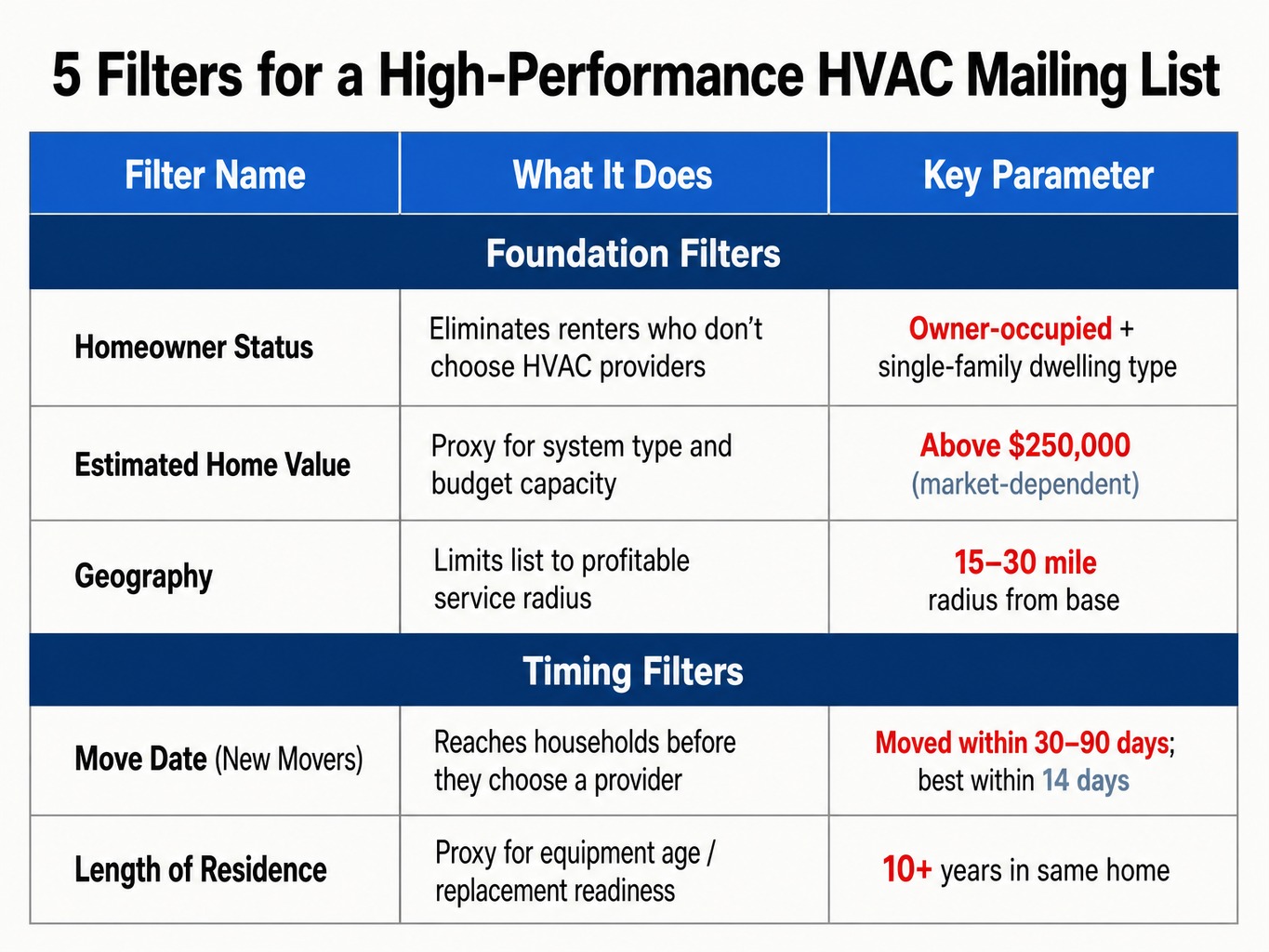
Five filters turn a zip-code dump into a list that books HVAC sales leads.
Read more: Homeowner Lead Lists – Email and Mailing Lists from Infofree
Every Home vs. Targeted Mailing Lists: When Each One Wins for HVAC
The InfoFree Complete Address Master or Every Door Direct Mail (EDDM) and targeted lists aren’t competing strategies; they are different tools for different jobs. The right choice depends entirely on your campaign goal.
EDDM is a USPS program that delivers your mailer to every address on a chosen mail carrier route at a low saturation postage rate, currently around $0.18 to $0.22 per piece. Complete Address Master provides similar total saturation of every address in a carrier route.
- When it wins: EDDM/CAM is best for broad brand awareness campaigns where geographic saturation is the goal. Use it for announcing a grand opening, launching in a new service area, or running a seasonal blitz with a universally appealing offer like a “$49 Service Fee.”
- The trade-off: You get zero filtering capabilities. Your postcard goes to every apartment, renter, and business on the route, which means a significant portion of your spend is on unqualified recipients.
Targeted Mailing Lists are built using the demographic and household filters discussed earlier. You pay more per piece due to list acquisition costs and first-class postage, but you only mail to qualified households.
- When it wins: Targeted lists are the clear winner for any campaign focused on generating high-value booked jobs. Use them for system replacement offers, maintenance agreement upsells, and new-mover campaigns.
- The trade-off: The per-piece cost is higher, and it requires access to a data platform with granular filters.
Here’s the decision rule: If your goal is maximum brand exposure in a new territory and your offer is broad, CAM/EDDM is a cost-effective tool. If your goal is to book profitable jobs from a defined audience segment, a targeted list is the only logical choice.
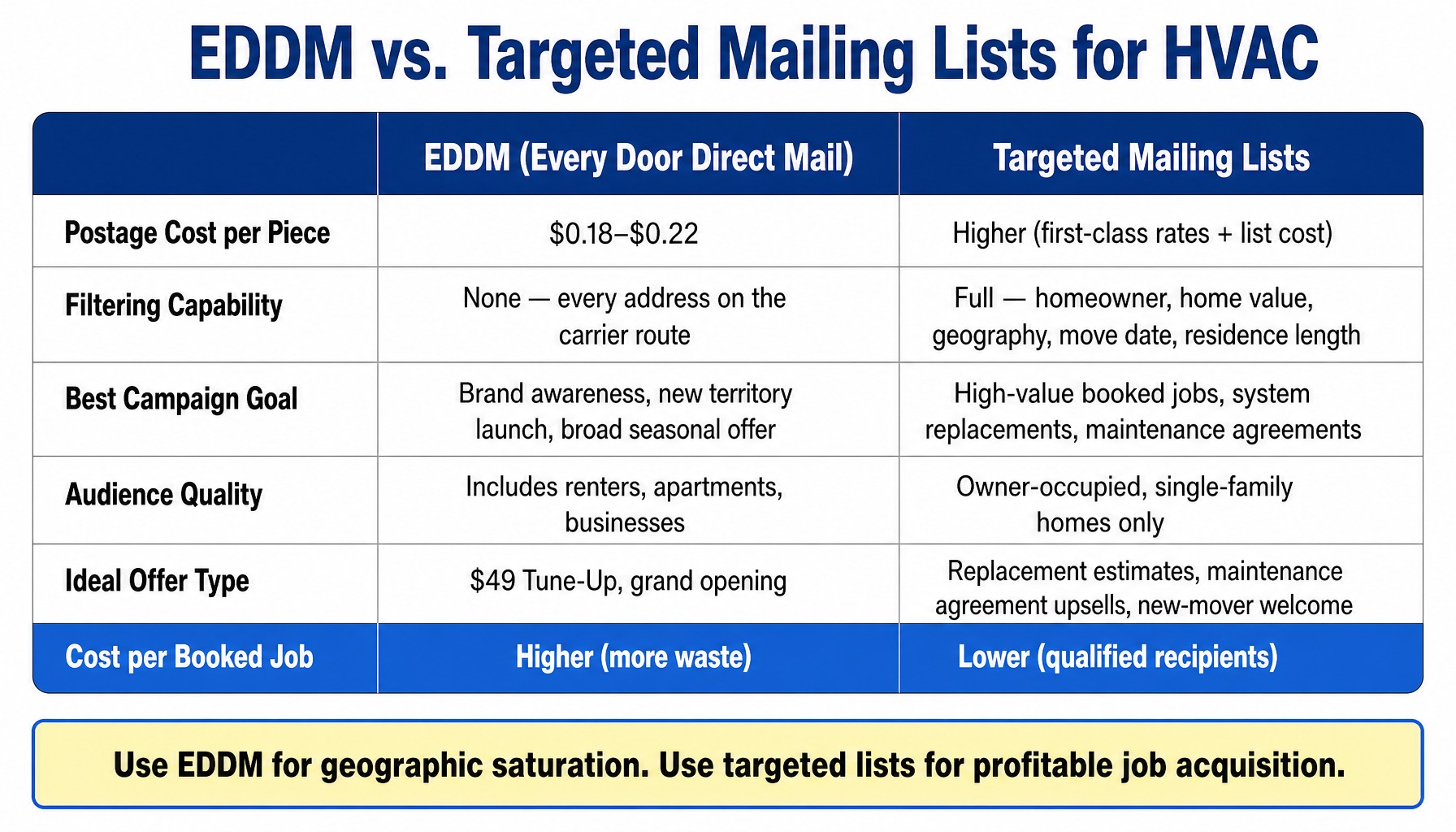
Choosing between EDDM and targeted lists depends on your HVAC campaign goal.
What Goes on the Postcard: Anatomy of an HVAC Mailer That Earns a Call
Once the list is right, the postcard’s job is to give the homeowner a specific and compelling reason to call now. A great design on a bad list is wasted money, but a weak design on a great list leaves money on the table.
Focus on three core elements:
Format: Oversized postcards (6″x9″ or 6″x11″) consistently outperform standard 4″x6″ mailers for home services. Their size helps them stand out in the mailbox, ensuring the homeowner sees your headline before deciding whether to keep or discard the piece. While letters in envelopes can work for existing customers, their higher cost and friction of opening make them less effective for cold prospecting.
Offer: Vague calls to action like “Call for a Quote” don’t work. The homeowner needs a specific, time-bound reason to act. The three offer types that consistently drive HVAC sales leads are:
A seasonal tune-up at a fixed price (e.g., "$79 AC Check-Up").
A discount on a first repair (e.g., "20% Off Your First Service Call").
A free, no-obligation estimate on a new system installation.
Always include a deadline (“Offer expires May 31st”) to create urgency.
Response Mechanism: Never use your main office number on a mailer. Always use a dedicated tracking phone number for each campaign. Also, include a QR code that links to a landing page repeating the same offer. This not only makes it easy for the homeowner to respond but also provides two ways to track attribution. As a practical matter, customers are responsible for following all applicable local, state, and federal laws when using mailing, calling, or email data including the TCPA, DNC rules, CAN-SPAM, and state privacy statutes. InfoFree provides the data; it is not liable for how customers use it.
When to Drop: Seasonal Cadence and the New-Mover Window
After list quality, timing is the largest lever you can pull to improve ROI. Most HVAC contractors mail during peak season June for AC, December for heating when every competitor is also flooding mailboxes.
The higher-ROI window is the shoulder season: the 4–6 weeks before peak demand hits. This is when homeowners are starting to think about their systems but haven’t yet been buried in offers.
- For cooling markets: Mail AC tune-up offers from late March through April.
- For heating markets: Mail furnace check offers from late August through September.
Furthermore, a single mail drop is a lottery ticket. A sequence of three to five touches to the same targeted list over 8–12 weeks consistently converts at a higher rate. Industry studies show multi-touch campaigns can outperform single drops by a wide margin. The first piece builds recognition, the second builds familiarity, and the third earns the call. For example, an AC tune-up campaign could involve three drops: an early-bird offer in late March, a reminder in mid-April, and a “last chance” mailer in early May.
New-Mover Timing: Why 14 Days Matters More Than 60
For new-mover campaigns, the timing window is even tighter and the data’s decay curve is steeper. A household that moved within the last 14 days is actively searching for local service providers. By day 30, they’ve made initial choices. By day 60, that window of opportunity is largely closed.
This means a new-mover direct mail program cannot be run on a list purchased once a quarter. To be effective, you need to pull fresh data sourced from deed transfers or new utility connections at least bi-weekly or monthly. Mailing small, frequent, fresh drops is the only way to consistently reach new homeowners before your competitors do.
Read more: New Homeowner Lists – Email and Mailing Lists from Infofree
Tracking Which Mailers Actually Booked a Job
Most contractors track response rate (how many calls they got), but that’s a vanity metric. The only number that matters is your cost per booked job.
A $1,200 mailer that generates 30 calls and 8 booked jobs has a cost per acquisition of $150. A second mailer at the same cost that generates only 15 calls but converts 12 of them into jobs has a cost per acquisition of $100. The second list was better, even though it produced fewer raw calls. Contractors who reconcile call-tracking logs against their dispatch or field-service software consistently find a gap between call volume and actual booked jobs large enough to change which campaign was the real winner.
Here are three methods to track true ROI:
- Dedicated Tracking Phone Numbers: Use a service like CallRail or WhatConverts to assign a unique, trackable phone number to each mail campaign. This automatically tags every inbound call to the specific list and postcard that generated it.
- QR Codes and Landing Pages: A QR code on your mailer should direct to a campaign-specific landing page. You can track scans and form submissions to measure digital response from your physical mail.
- Match-Back Analysis: This is the most accurate method. After a campaign, export a list of new customers from your CRM or field-service platform (like ServiceTitan or Housecall Pro). Compare that list against your original mailing list to identify every booked job that came from a household you mailed, even if they called your main office line instead of the tracking number.
Attribution isn’t optional. Without it, you’re just guessing which lists and offers work.
Building HVAC Mailing Lists with Homeowner and Mover Filters in One Platform
The strategy is clear: how to get HVAC customers with direct mail depends on filtering by homeowner status, home value, geography, move date, and length of residence. The challenge is finding a single data source that provides all these filters without forcing you to buy from multiple vendors or pay steep per-record fees.
This is where a unified prospecting platform becomes essential. InfoFree’s consumer and household database allows you to build targeted marketing lists using the exact filters this guide recommends. Within one interface, you can segment by:
- Homeowner Status & Dwelling Type
- Estimated Home Value
- Geography (ZIP, Radius, County, or City)
- Move Date (for new movers)
- Length of Residence (for replacement targets)
You can build and export a targeted homeowner list for a seasonal campaign or set up recurring new-mover searches to keep your drops fresh. The platform’s subscription model includes unlimited search and view, with export credits governed by your plan, allowing you to test and refine segments without incurring per-list charges. It is important to note that InfoFree’s consumer and household records are compiled from a separate set of sources than its business database, and are not rated on the same 95% accuracy standard that applies only to business data.
Conclusion
If your direct mail isn’t performing, stop redesigning the postcard. The problem and the opportunity is almost always in the list.
The HVAC contractors who get a consistent return from direct mail are not the ones with the flashiest designs. They are the ones who mail only to owner-occupied homes in their service area, time their drops for the shoulder seasons and new-mover windows, and rigorously track their cost per booked job. They treat list building as a discipline, not an afterthought.
Before you approve your next print run, audit your mailing list. If you can’t filter it by homeowner status, estimated home value, and move date, the postcard doesn’t matter yet. Fix the list first.
Frequently Asked Questions
1. What size postcard gets the best response for HVAC direct mail?
Oversized formats 6″x9″ and 6″x11″ consistently outperform standard 4″x6″ postcards in home-services direct mail because they survive the initial mailbox sort. The trade-off is cost, as oversized pieces can be more expensive to print and mail. For most HVAC campaigns, the higher per-piece cost is justified by the visibility gain.
2. Can I target homeowners with older HVAC systems using direct mail?
No consumer mailing list includes equipment age directly. The practical proxy is length of residence: a homeowner who has lived in the same house for 12–15 years likely has an older HVAC system approaching its end of life. Filtering by length of residence above 10 years, combined with homeowner status, builds a replacement-ready audience.
3. How often should an HVAC company mail the same addresses?
For seasonal campaigns, a sequence of three to five mailers over 8–12 weeks to the same list outperforms a single drop. For new-mover campaigns, mail once within 14 days of the move date; repeat mailings have diminishing returns as the household quickly locks in providers. Retention mailings to existing customers perform well at quarterly intervals.
4. How do I calculate ROI on an HVAC direct mail campaign?
Divide your total campaign cost (printing, postage, list) by the number of booked jobs attributed to the mailing, not the number of calls. A $1,200 campaign that books 10 jobs has a cost per job of $120. Compare that to your average revenue per job and the customer lifetime value. Use match-back analysis against your field-service software to capture all attributed jobs.
5. How do new-mover mailing lists help HVAC companies get customers?
New movers have not yet chosen local service providers. Reaching them within the first 10–14 days of their move puts your company in front of a household with an active need and no existing loyalty. These lists are typically compiled from deed transfer records and utility connection data, so freshness is the critical variable for success.
6. Should I combine HVAC direct mail with digital ads?
Yes. The simplest method is to place a QR code on the postcard that links to a campaign-specific landing page with a retargeting pixel. Any homeowner who scans but doesn’t convert can then be shown follow-up display or social ads reinforcing the same offer. This creates multiple digital impressions from a single physical mail piece.