


Key Takeaways
- Self-built mailing lists for final expense insurance give agents exclusive territory control and a reusable data asset.
- The most effective list criteria are a narrow age band (60-75), a household income range of $20,000-$40,000, and dense geographic concentration.
- Use a business reply card (BRC) in a closed envelope rather than a postcard. The mailer’s only job is to generate a response, not sell the policy.
- Mail consistently: do at least three monthly drops to the same territory and follow up on every response within 24-48 hours.
- Clean your list with NCOA processing and deceased suppression before every drop to reduce wasted postage and protect your reputation.
Direct mail is one of the most productive channels for booking senior life insurance appointments. Most agents fuel their pipeline through some combination of vendor-purchased leads and self-built mailing lists. Vendor leads deliver immediate weekly volume with minimal operational lift: the vendor handles data, mail production, and delivers responders directly to the agent. Self-built lists give the agent exclusive control of a territory and a reusable data asset that costs less per contact on subsequent drops. Both approaches feed the same funnel and many agents use them in tendem.
This guide covers the self-built side of that equation. It works through the demographic filters that determine whether your mail piece reaches a qualifying prospect, the mail format decisions that increase responses, the drop cadence, and the hygiene steps that keep your postage from being wasted. You are responsible for ensuring all mailings comply with your state’s insurance advertising regulations, USPS requirements, and if you’re following up by phone TCPA and DNC rules.
The Economics of a Self-Sourced Final Expense List Program
Self-built lists and vendor-purchased leads have different cost profiles, and understanding the difference helps agents decide how much of each to run. A vendor lead is a contact that has already responded to an offer, so the agent is paying for a warm expression of interest. A self-built mailing list record is an uncontacted prospect the agent will convert into a lead through their own mail campaign. Both are legitimate ways to feed a pipeline but they carry different considerations and upfront costs.
Vendor lead pricing is easy to model. An agent buying 200 leads per month at $25-$35 each is spending $5,000-$7,000 a month, or $60,000-$84,000 a year. Those leads may be exclusive or shared across 2-5 agents in the territory, and the agent cannot re-contact them through the same channel because the underlying inventory belongs to the vendor.
A self-built program shifts more of the workflow onto the agent but delivers a different cost curve. A typical drop breaks down like this:
- Data: 10,000 consumer records filtered by age and income cost roughly $0.03-$0.10 per record, totaling $300-$1,000.
- Printing & Mail House: A 10,000-piece drop costs around $0.35-$0.60 per piece for printing and handling.
- Postage: Presort Standard mail runs about $0.34 per piece.
That puts the first drop at roughly $4,000-$7,000 all-in, with 50-150 responders at a typical 0.5%-1.5% response rate on a cold list. The real economic separation from vendor leads appears on later drops: because the agent already owns the underlying list data, re-mailing non-responders in the same territory 60-90 days later requires only printing and postage, not new data cost.
Neither model is universally the right choice. Vendor leads suit agents who need consistent weekly appointment volume without managing a mail house relationship, and who value the certainty of buying pre-responded contacts. Self-built lists suit agents who want exclusive territory ownership, are running direct mail at enough scale to justify the operational setup, and want their marginal cost per contact to decline over the year. The most common pattern is running both using vendor leads for consistent baseline volume and a self-built list program to build density in a chosen territory.
List Criteria That Determine Whether Your Mailer Gets Opened or Trashed
Your list criteria are the single largest lever on response rate. A well-filtered list of 5,000 records will consistently outperform a loosely filtered list of 20,000 because the mail reaches households that are statistically more likely to need and afford a $5,000 to $25,000 whole life policy.
The five filters that matter most for final expense lead generation are age band, estimated household income, homeowner status, geography, and marital status. Each filter narrows the universe of available prospects but increases the percentage of recipients who match the ideal customer profile.
Age Band and Income: Where the Product Fits
The standard industry targeting window for final expense is age 50-80 with an estimated household income between $15,000 and $50,000. The sweet spot for generating high-quality burial insurance responses is often narrower: age 60-75 and income $20,000-$40,000.
This segment is old enough to feel urgency about end-of-life costs but generally young and healthy enough to qualify for simplified-issue underwriting at affordable premiums. Filtering below $15,000 in household income increases the nixie rate (returned mail due to transient housing) and reduces the likelihood that the prospect can afford even a $30 monthly premium. Filtering above $50,000 means you’re mailing to prospects who likely already have coverage or sufficient assets to self-insure.
When building your list, the data fields to use are Estimated Age or Date of Birth Range and Estimated Household Income Range.
Geography and Homeowner Status: Density vs. Spread
For a solo agent, geographic concentration matters more than geographic breadth. Mailing 5,000 pieces across 10-15 adjacent ZIP codes produces a denser appointment territory than scattering the same volume across 50 ZIPs. This practice, often called hot zone mapping, reduces drive time and increases the odds of getting multiple responses in the same neighborhood.
Carrier-route sorting does more than reduce postage. It also works as a micro-geographic filter, since carrier routes within the same ZIP code can have very different demographic profiles that broad ZIP-level targeting simply does not catch.
Homeowner status is a powerful secondary filter. Homeowners at the same income level tend to have more stable addresses and higher response rates than renters. While filtering to homeowners only will reduce your available universe, it often improves the cost-per-response by eliminating households less likely to engage with mail. The key data fields here are ZIP Code, County, and Homeowner Status.
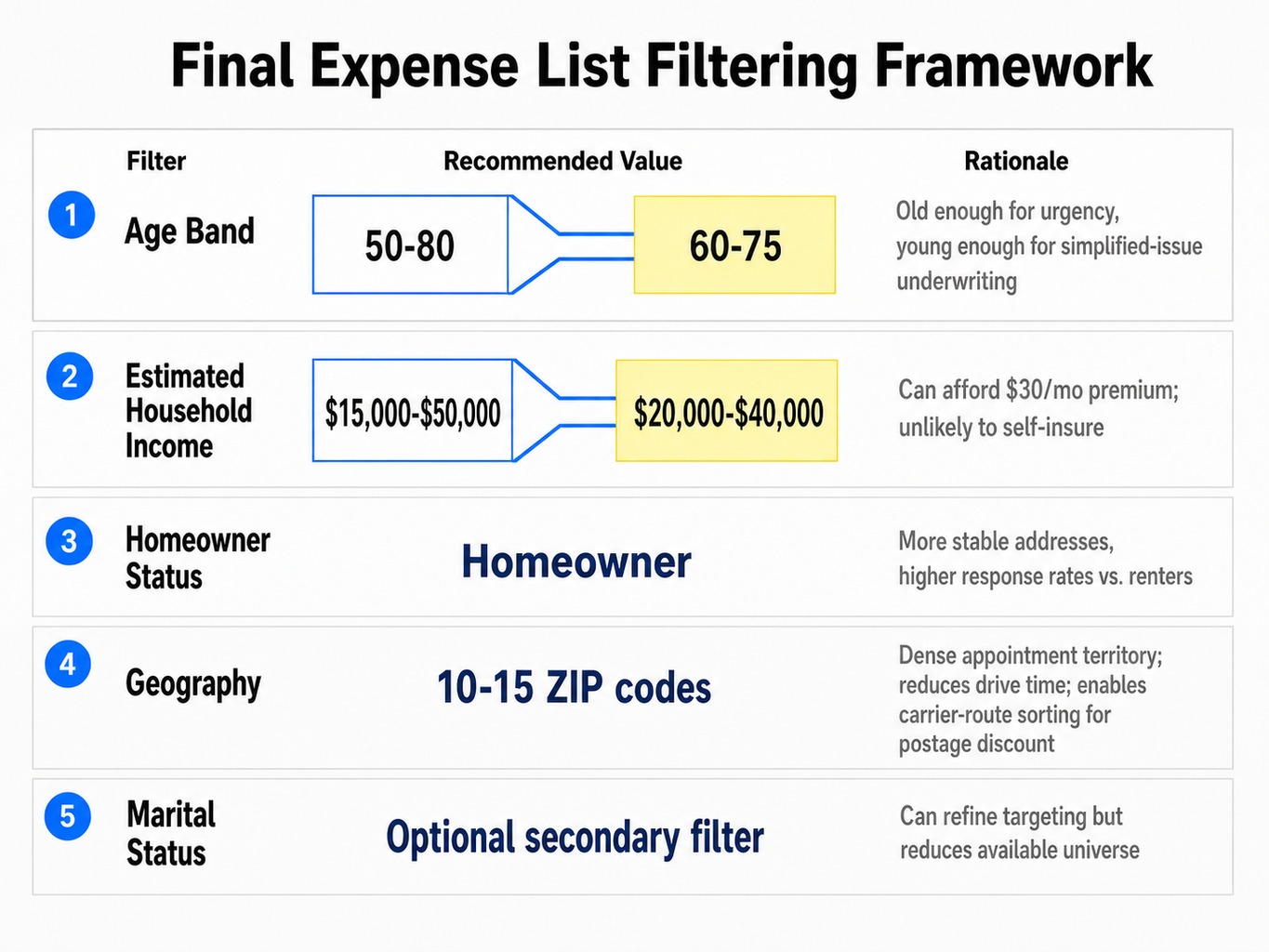
These five filters determine whether your final expense lead generation mailer reaches the right households.
Read more: ZIP Code Mailing Lists – Buy Mailing Lists by ZIP Code from Infofree
What to Put on the Mail Piece and What to Leave Off
The mail piece has one job: get the recipient to respond. It is a lead generation device, not a sales brochure. The actual sale happens at the kitchen table or on the phone. Overloading the mailer with information gives the prospect a reason to self-disqualify before you ever get a chance to speak with them.
Focus on three core decisions:
Format: A 6×9 postcard is cheap to print, but it often gets lost in the daily mail shuffle. A letter-sized piece in a closed envelope with a business reply card (BRC) consistently outperforms postcards. The envelope format signals importance, and the physical BRC gives the recipient a simple, low-friction action to take. Response rates vary based on audience, offer, creative, timing, and campaign consistency but the response device format often controls who responds more than the headline copy does.
Headline and Copy: The most effective final expense headlines reference the specific concern “Your Family Should Not Have to Pay for Your Funeral” rather than the product category “Affordable Life Insurance for Seniors.” The first headline names the fear the prospect already has. The copy should be simple, direct, and focus on the benefit of peace of mind. Avoid using the word “free” in headlines, as it triggers skepticism and may conflict with state advertising rules.
Compliance: Every state’s department of insurance has advertising rules that govern what can and cannot be stated on a mailer, including required disclosures about the product being insurance. You are responsible for reviewing these guidelines and ensuring your mail piece is compliant before you print and mail a single piece.
Drop Schedule and Follow-Up Timing: When to Mail and When to Call
Most agents under-mail and over-wait. The standard mistake is dropping one batch of 5,000 pieces, waiting 30 days for responses to trickle in, and then deciding direct mail doesn’t work.
A successful self-sourced program requires consistency. It takes at least three consecutive monthly drops to the same territory before response patterns stabilize. The first drop builds awareness; the second and third catch prospects who weren’t ready to act the first time. For a solo agent, a monthly or bi-monthly drop of 5,000 to 10,000 pieces is a sustainable cadence, adjusted based on how many appointments you can realistically run per week.
Follow-up timing is even more critical. When a BRC or phone call comes in, you must make contact within 24-48 hours. A lead that sits for seven days is not a lead; it’s a name on a piece of paper. The prospect’s emotional urgency fades, they forget they responded, or they get contacted by a competing agent. Following up within 24-48 hours gives the agent an opportunity to reach prospects while their response is still recent.
While not required, some agents increase their effective response by calling non-responders 7-10 days after the mail drop. If you choose this path, you must scrub your call list against the National Do Not Call Registry and comply with the TCPA and all applicable state telemarketing laws. Customers are responsible for their own compliance; the underlying list data does not grant permission to call.
Returned Mail, Bad Addresses, and List Decay: The Maintenance Nobody Talks About
A mailing list is a depreciating asset. Every month, a percentage of your records become invalid due to moves, deaths, and address changes. For a final expense list targeting seniors, this decay rate is higher than on general consumer lists.
A “nixie” rate (returned as undeliverable) above 5-8% on a first drop signals that the list was not properly cleaned before mailing. This means you paid to print and mail pieces that never had a chance of arriving.
Two hygiene steps are non-negotiable before every drop:
NCOA Processing: The National Change of Address system cross-references your list against USPS move data from the prior 48 months. Running your list through an NCOA process is a standard service offered by any reputable mail house.
Deceased Suppression: This process removes records of individuals who have died. Suppressing deceased records is not just about saving postage; mailing a final expense solicitation to a household that just lost someone is the fastest way to destroy your reputation in a neighborhood.
Because of this rapid decay, you should refresh or re-pull your list for the same territory every 90-120 days. Always suppress prior responders and prior nixies from each new pull to ensure you’re only mailing to fresh, deliverable prospects.
Where InfoFree Fits
The self-sourced approach depends on having a reliable source of consumer demographic data at a cost that makes the economics work. InfoFree gives agents direct access to the underlying consumer records that many direct mail campaigns are built on approximately 270 million consumer records, searchable by the same filters this guide has walked through:
- Age range (e.g., 60-75)
- Estimated household income range (e.g., $20,000-$40,000)
- Homeowner status
- ZIP code, county, or radius
You can then build and export your list for use with a mail house or print shop. Because InfoFree compiles its consumer database in-house from thousands of sources and offers a flat-rate subscription with unlimited search and view, you can test different filter combinations and re-pull the list for subsequent drops. Export limits vary by plan, and the consumer database is not rated on the same 95% accuracy standard that applies to InfoFree’s business data.
For agents already running vendor-sourced final expense leads, InfoFree can serve as a complementary source of list data the two channels feed the same funnel with different cost and workflow profiles. When using any exported data, customers are responsible for following all applicable local, state, and federal laws, including state insurance advertising rules, USPS regulations, TCPA and DNC rules where phone follow-up applies, and deceased-suppression best practices. InfoFree provides the data; it is not liable for how customers use it.
Running the Program
Final expense direct mail works best for agents who run it like an operational discipline, not a one-off campaign. Choosing the right demographic filters, using a BRC format that pulls responses, keeping a consistent monthly drop cadence, following up within 48 hours, and treating list hygiene as an ongoing task are the mechanics that determine whether the channel produces stable appointment volume.
Over time, tracking response, appointments, and conversion by mailing helps agents understand which audiences and campaigns produce the strongest results and adjust the mix of vendor-sourced leads and self-built list drops based on what the data shows.
Frequently Asked Questions
What is the difference between exclusive and shared final expense direct mail leads?
Exclusive leads are sent to one agent only. Shared leads are sold to 2-5 agents in the same territory, creating immediate competition to reach the prospect first. Exclusive leads generally close at higher rates than shared leads because there’s no competing agent racing to reach the same prospect, though they typically cost more from vendors. The exact gap varies by territory, agent follow-up speed, and product.
How many pieces do I need to mail before I can judge whether final expense direct mail works?
Most industry trainers recommend at least three consecutive monthly drops of 5,000-10,000 pieces to the same territory. A single drop doesn’t produce a reliable response pattern recipients are more likely to respond after seeing a mailer two or three times. Judging the channel on one drop is the most common reason agents abandon direct mail prematurely.
Can I combine final expense direct mail with digital retargeting?
Yes. Some agents upload their mailing list to Meta or a programmatic display platform to serve digital ads to the same households before or after the mail drop, a tactic called matched-audience retargeting. Additionally, USPS Informed Delivery provides a digital preview of mail, creating a second impression at no extra cost. Both approaches can lift response rates.
What carrier products pair best with direct mail final expense leads?
Direct mail leads tend to perform best with simplified-issue whole life products in the $5,000 to $25,000 face amount range. Carriers with quick underwriting and broader health tolerance, along with guaranteed-issue options for prospects who do not qualify for simplified issue, give you a practical fallback at the kitchen table. Keep at least two to three carrier grids on hand.
How do I calculate my break-even point on a final expense mail drop?
Start by adding the full cost of the drop: data, printing, and postage. Then divide that total by the number of issued policies the drop produced. Compare that cost per issued policy to your average first-year commission. For example, a $5,000 drop that produces 6 policies with $600 in first-year commission each has a cost per policy of $833. Consistent re-mailing into the same territory lowers the average cost per policy over time because later drops do not require new data spend.