


Key Takeaways
Email list hygiene depends on the type of list and how it will be used. Compiled prospecting lists and opt-in subscriber lists require different approaches to maintaining quality and deliverability.
-
For prospecting lists, focus on pre-send verification. Bulk verification tools can help identify invalid addresses, role-based accounts, catch-all domains and other potential delivery issues before a campaign is sent.
-
For subscriber lists, focus on engagement. Clicks, replies and other meaningful engagement signals—not just opens—can help identify inactive contacts. A sunset policy for persistently inactive subscribers can help maintain list quality and protect sender reputation.
-
Compliance remains the sender’s responsibility. This includes honoring unsubscribe requests under CAN-SPAM and, where applicable, screening against Do Not Call (DNC) requirements, regardless of the source of the data.
-
Data quality starts with the source. A well-compiled, regularly updated prospecting database can reduce the amount of downstream cleaning and verification needed before data is used in an email program.
Much of the advice about email list hygiene is built around a specific type of email program: one where an organization builds its own audience through opt-in forms, manages an ongoing subscriber relationship, and uses engagement to determine who should remain on the list.
That approach makes sense for subscriber lists, but it does not always translate to prospecting lists used in B2B sales and B2C direct marketing. Compiled databases, purchased contacts and CRM imports may contain contacts who have not previously opted in to receive communications from the sender. In these cases, list hygiene begins with different questions—such as whether an address is valid, deliverable and appropriate to contact—rather than whether an existing subscriber should be re-engaged or sunset.
The two approaches share some fundamentals, but the processes diverge in important ways. This guide examines the different ways these lists can decay, the verification steps that can improve list quality, and the suppression practices that help manage both. The goal is to apply the right hygiene process to the type of list you’re actually using—supporting deliverability, compliance and a better opportunity for your messages to reach the right audience.
Why Prospecting Lists and Subscriber Lists Need Different Hygiene Rules
The core distinction is permission. A subscriber list is built from people who opted in to hear from you, creating an implicit relationship and a baseline of engagement to measure against. A prospecting list is built from compiled or purchased data where the recipient has no prior connection to your brand. The first email is the introduction, not a continuation.
This difference changes every downstream hygiene decision.
For subscriber lists, list hygiene is about identifying who has stopped engaging and deciding when to suppress them to protect your sender reputation. The primary signals are behavioral: opens, clicks, and replies.
For prospecting lists, hygiene is about verifying that a record is technically deliverable and legally contactable before the first send. You have no engagement history to reference. Your primary signals are infrastructural: Does the mailbox exist? Is the domain valid? Is the contact on a suppression list?
Consider a B2B sales team that exports 5,000 executive contacts from a prospecting database like InfoFree and loads them into their email service provider (ESP). They cannot run a re-engagement campaign on contacts who were never engaged. They cannot set a sunset policy based on open-rate decay when there is no open-rate baseline. Their hygiene workflow must start with verification, suppression-list matching, and compliance checks not engagement scoring.
Applying subscriber-list hygiene rules to a prospecting list is structurally wrong. The rest of this guide explains the right workflow for each.
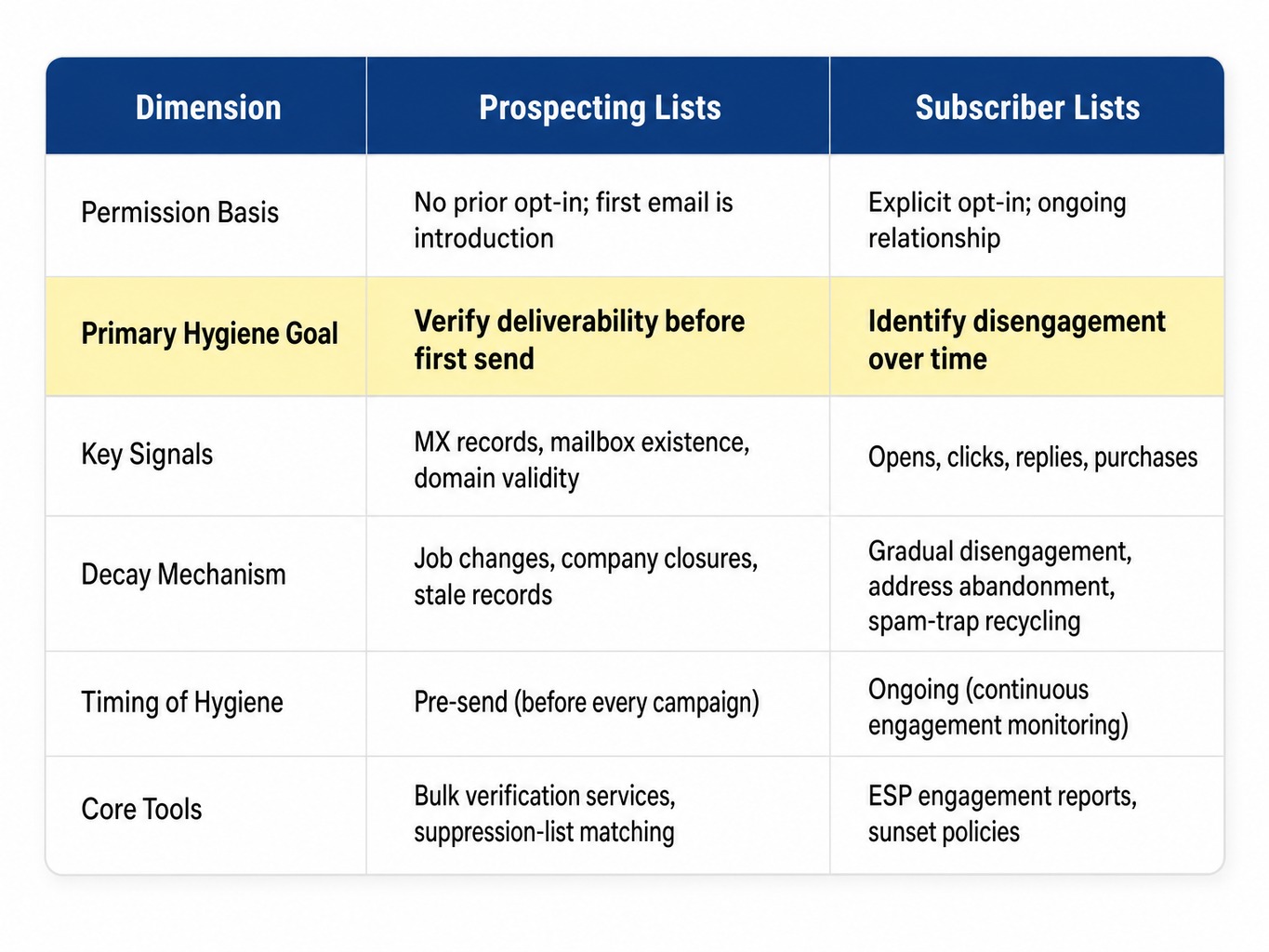
Prospecting and subscriber lists demand different list hygiene approaches at every level.
How Email Lists Decay and Why the Timeline Differs by List Type
All email lists lose deliverable addresses over time, but the rate and the causes depend on the source. The commonly cited figure that roughly 20-25% of an email list decays annually is an average that obscures two very different mechanisms. Hard bounces above 2% on a single send can trigger ESP-level throttling or suspension, and that risk profile changes based on how your specific list type decays.
Prospecting List Decay: Job Changes, Company Closures, and Stale Records
Prospecting lists, especially B2B executive lists, decay primarily through structural changes in the real world. A contact’s email address, verified as valid 60 days ago by the data compiler, may be invalid today because the person changed jobs. With median employee tenure sitting around four years and turnover running faster in sales and tech roles, this is a constant source of decay.
B2C prospecting lists rot through different but equally potent changes. The USPS processes tens of millions of address changes per year as households move, rendering homeowner and resident data stale. People change names, switch internet service providers, or abandon old email accounts.
The key point is that prospecting-list decay is invisible until you send. You have no passive engagement signal to detect it. The only way to catch it is through active, pre-send verification.
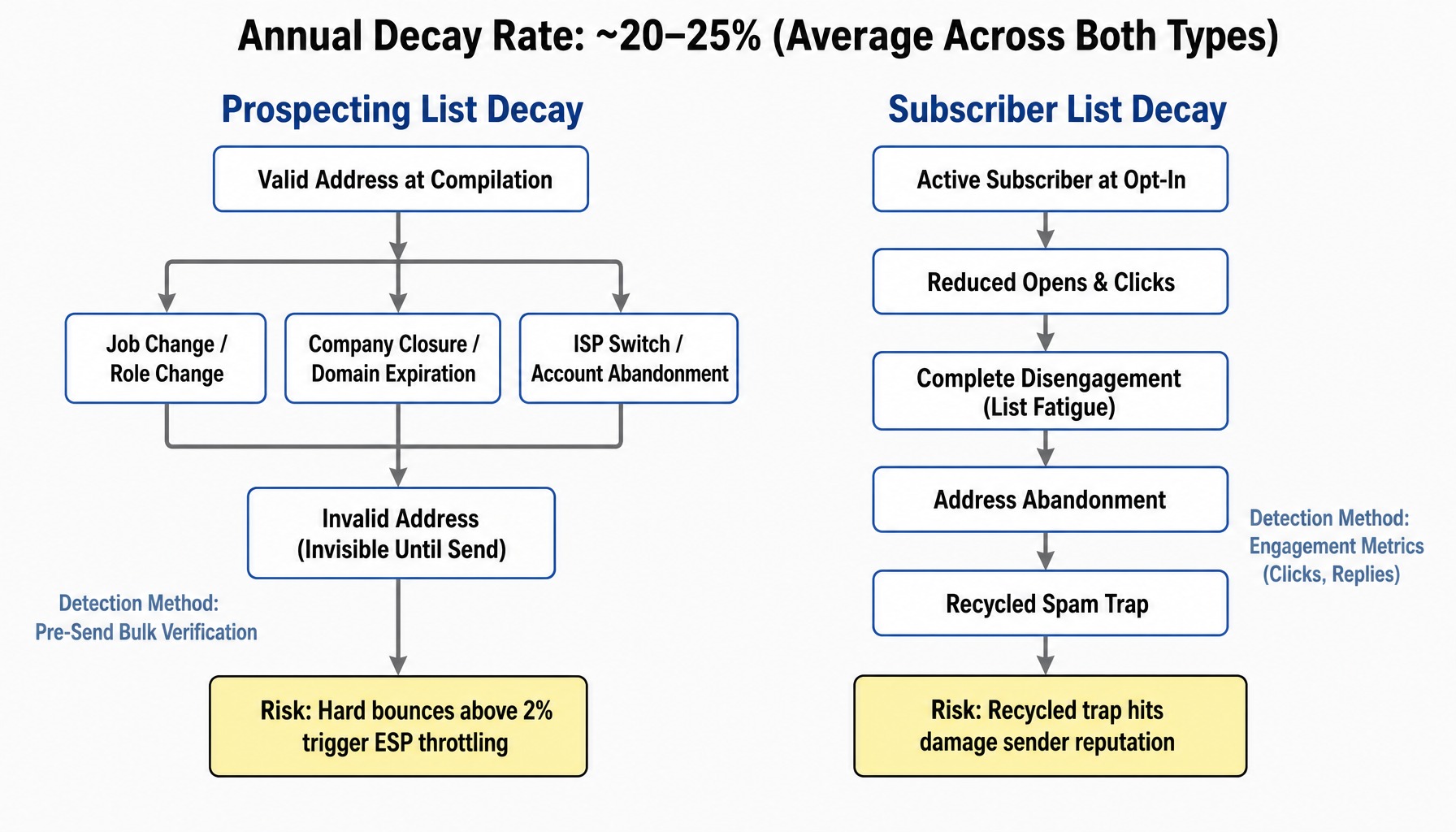
List decay follows different paths clean email list practices must match the mechanism.
Subscriber List Decay: Disengagement, Abandonment, and Spam-Trap Recycling
Subscriber lists decay through a different mechanism: gradual disengagement. A contact who opted in 18 months ago may still have a valid mailbox but has simply stopped opening, clicking, or purchasing. This is often called list fatigue.
Over time, some of these disengaged addresses get abandoned entirely. When that happens, mailbox providers like Gmail and Yahoo may repurpose them as recycled spam traps meaning a once-valid subscriber address becomes a direct threat to your deliverability. A recycled trap hit tells the provider you’re emailing unmonitored mailboxes, a strong signal of poor email list hygiene.
This is distinct from pristine traps, which are email addresses that were never valid and exist only to catch senders who use scraped or fraudulent lists. For subscriber lists, recycled traps are the bigger risk. This decay is detectable through engagement metrics, which is why engagement-based segmentation works for this list type.
Email List Hygiene for Prospecting Lists: Verify Before You Send
A common failure pattern: a sales team imports a purchased executive list into their ESP without pre-verification and sends a single campaign. The hard bounce rate spikes above 8%, the ESP throttles their sending domain within hours, and a remediation plan is demanded. The team loses a two-week window on a time-sensitive campaign all because the upstream verification steps were skipped.
When working with a prospecting list, your hygiene workflow runs before the first send. The two priorities are technical verification (is the address deliverable?) and compliance suppression (is the contact legally contactable?).
Pre-Send Verification: MX Validation, Role-Based Filtering, and Catch-All Detection
Before you send to any compiled or purchased list, it must pass through at least three layers of verification.
- MX Record Validation: This is the most basic check, confirming that the recipient’s domain (e.g., company.com) has a functioning mail server configured to receive email. Any address at a domain without a valid MX record is undeliverable.
- Role-Based Address Filtering: This step flags and removes generic addresses like info@, admin@, and sales@. While often deliverable, these route to shared inboxes, generate low engagement, and have a higher propensity for spam complaints. Most bulk verification tools allow you to suppress these automatically.
- Catch-All Domain Detection: Some domains are configured to accept all inbound mail, regardless of whether a specific mailbox exists. This makes verification tricky, as the server will return a positive response for any address. A good verification service will identify these “accept-all” or “unknown” domains, allowing you to treat them as a higher-risk segment or suppress them entirely, as they can mask a high number of invalid contacts.
Bulk verification services like ZeroBounce, NeverBounce, and Kickbox perform these checks at scale. The most reliable method, SMTP handshake verification, pings the mail server to see if the mailbox exists without sending a message, but it is sometimes throttled or blocked by providers.
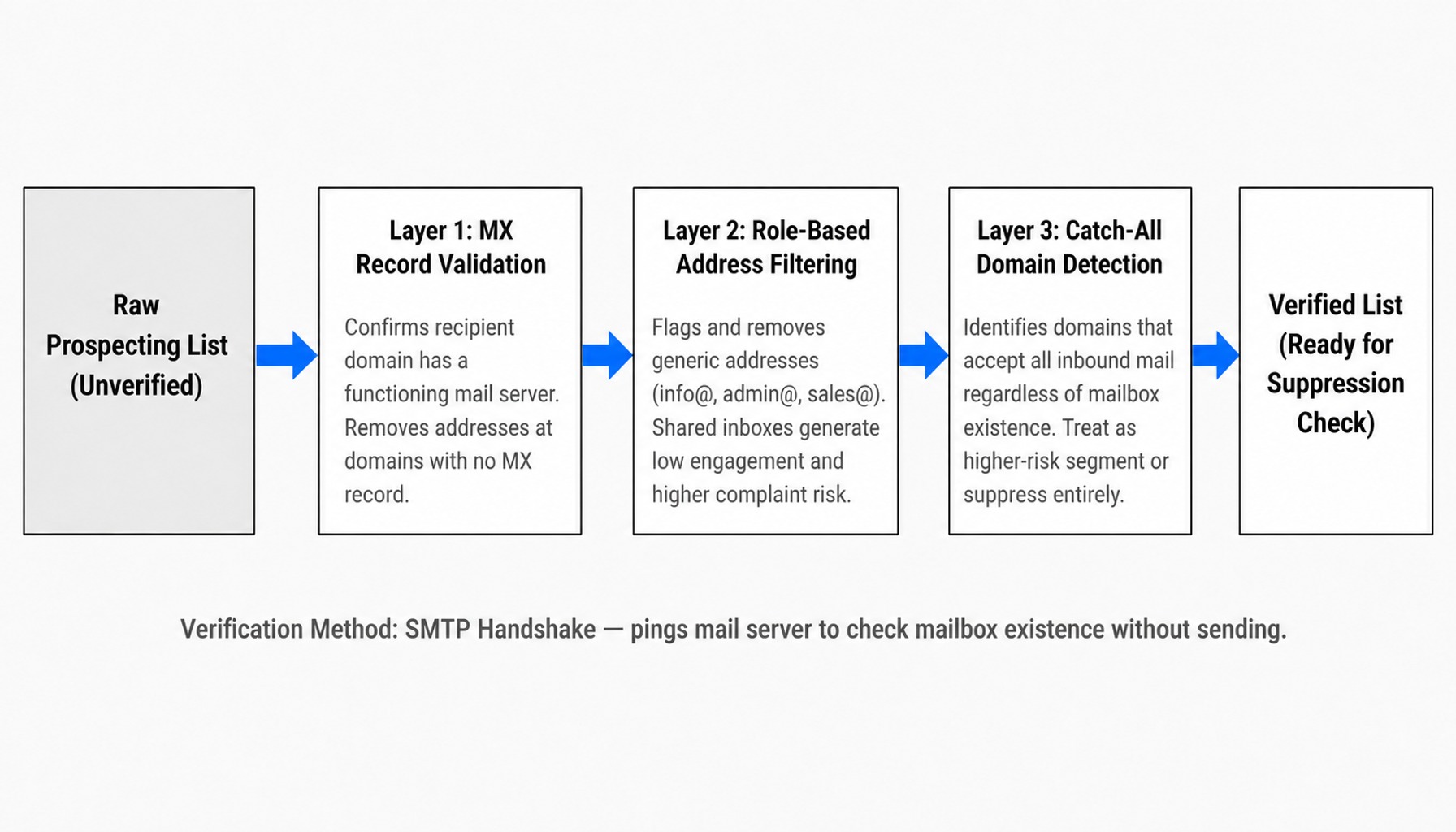
Email list hygiene best practices start with this three-layer verification before any send.
Suppression Management: DNC, CAN-SPAM, and State Privacy Obligations
Prospecting-list hygiene isn’t just technical; it’s a compliance function. Before sending, you must scrub your list against your internal suppression files. This is not a one-time step but an ongoing process. A financial advisory team running monthly prospecting campaigns, for example, needs to merge each new export against their cumulative suppression file before every send.
Read more: Financial Advisor Lists – Email, Phone and Mailing Lists from Infofree
This file should contain:
- Prior Unsubscribes: Under CAN-SPAM, an opt-out request is permanent and applies across all campaigns.
- Hard Bounces & Complaints: Any address that has previously hard-bounced or generated a spam complaint should be permanently suppressed.
- DNC Registries: If your campaign involves phone follow-up, you must scrub against federal and state Do Not Call lists.
This process also requires careful deduplication. On compiled lists, you can’t rely on email addresses alone, as the same person may appear with different emails across sources. Matching logic needs to layer company name, physical address, and contact name to catch duplicates that single-field matching misses.
Crucially, the sender not the data provider is responsible for maintaining compliance with DNC, TCPA, CAN-SPAM, and applicable state privacy laws when emailing, calling, or mailing prospects.
Email List Hygiene for Subscriber Lists: Engagement-Based Cleaning
For subscriber lists, hygiene is about identifying who has stopped listening and deciding when to stop talking to them. This protects your sender reputation from the drag of unengaged contacts, which helps you stay below the 0.3% spam complaint threshold that Google and Yahoo introduced in their 2024 bulk sender requirements. The two core tools are engagement-based segmentation and a sunset policy.
Engagement-Based Segmentation: Defining Inactive in Your Context
The definition of “inactive” is relative to your send frequency, not a universal calendar date. A weekly sender might define inactive as no opens or clicks in 90 days (after ~12 sends). A monthly sender might use a 180-day window (after 6 sends). The key is to define a threshold based on a reasonable number of attempts.
However, there’s a critical complication: Apple’s Mail Privacy Protection (MPP), launched in 2021. MPP pre-fetches email images, which artificially inflates open rates for users of Apple Mail. This means open rate alone is no longer a reliable engagement signal.
To accurately identify inactive subscribers today, you must prioritize more concrete signals:
- Click Rate: A user actively clicking a link is a definitive engagement.
- Reply Rate: A direct reply is the strongest signal of all.
- Website Activity: Tracking if a subscriber has logged in or made a purchase.
Your segmentation rules should be re-written to weigh clicks and other actions far more heavily than opens.
Sunset Policy Design: Gradual Suppression vs. Hard Cutoff
A sunset policy is your automated rule for when and how you stop emailing unengaged subscribers. You have two primary design patterns:
- Hard Cutoff: Suppress anyone inactive beyond your threshold (e.g., 180 days) with no re-engagement attempt. This is simple but risks removing contacts who might have re-engaged at a lower frequency.
- Gradual Suppression: Reduce send frequency for inactive contacts, then attempt one final re-permission campaign before suppression.
For most senders, gradual suppression is the better approach. It preserves the option to recover contacts while still protecting your reputation. A practical design looks like this:
- After 90 days of inactivity: Reduce send frequency to once per month.
- After another 90 days at reduced frequency with no engagement: Send a final “re-permission” email asking if they wish to stay subscribed.
- If no response: Suppress the contact.
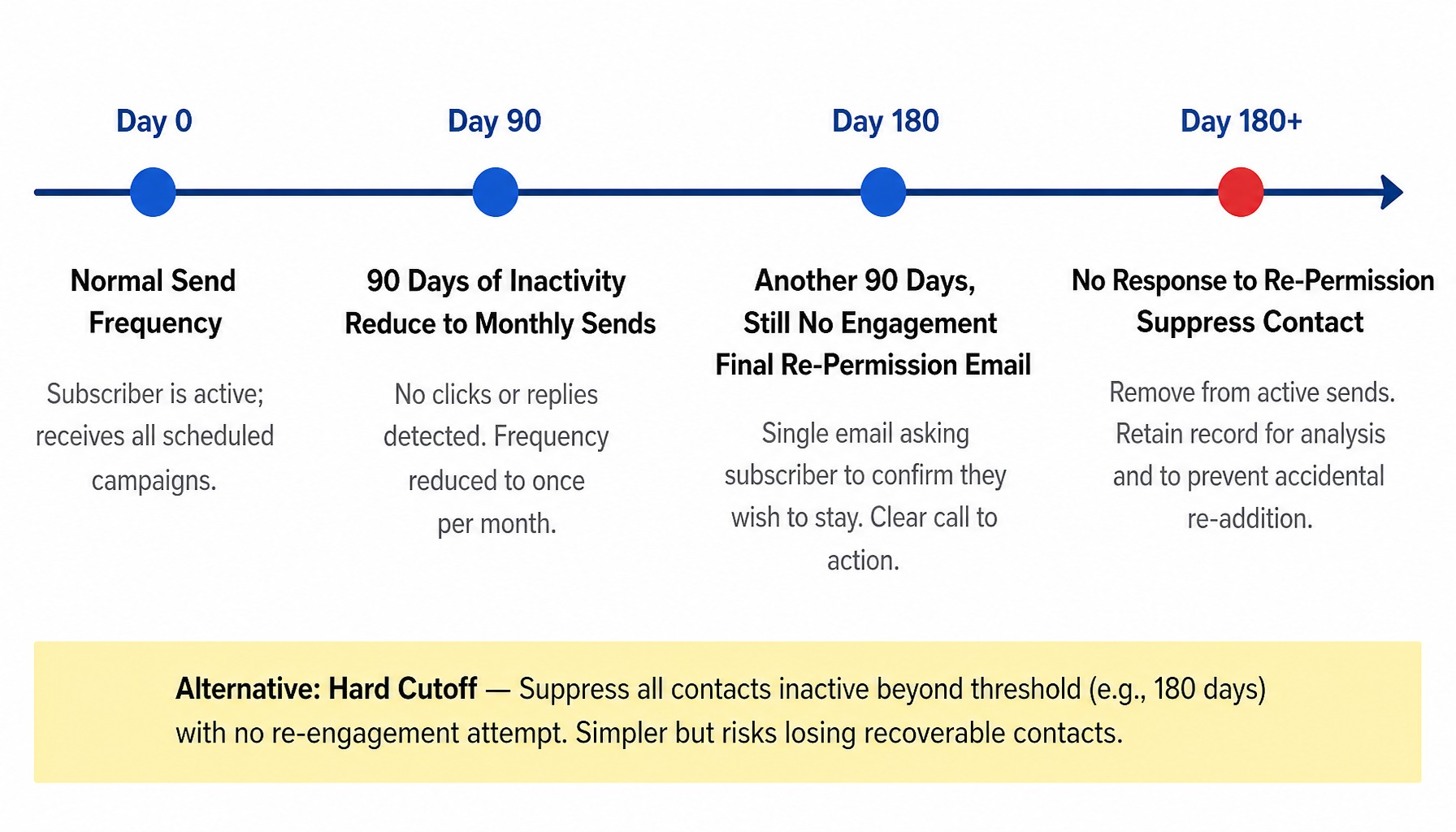
A well-designed sunset policy is the backbone of subscriber list hygiene.
Note that suppression (removing from active sends but retaining the record) is generally preferable to deletion. It preserves the data for analysis and prevents the contact from being accidentally re-added later.
Verification Tools and Methods Worth Knowing
The tools you use for email list hygiene depend on your list type and workflow. They fall into four main categories.
- Bulk Verification Services: These platforms (e.g., ZeroBounce, NeverBounce, BriteVerify) accept a file upload (like a CSV) and return results flagged by status: valid, invalid, risky, catch-all, and role-based. This is the primary tool for cleaning prospecting lists before a campaign.
- Real-Time API Validation: Services like the Mailgun or Kickbox API can be integrated directly into forms to verify an email address at the moment of capture. This is the best way to prevent bad addresses from ever entering your subscriber list.
- ESP-Native Tools: Your email platform (e.g., Klaviyo, HubSpot, Brevo) has built-in reporting to flag disengaged or bounced contacts. These are essential for managing subscriber-list hygiene but do not replace pre-send verification for prospecting lists.
- Reputation & Inbox Monitors: Tools like Google Postmaster Tools and Microsoft SNDS provide diagnostics on your domain and IP reputation. They show if you’re being throttled or blocklisted. While diagnostic, not preventive, they are the first place to look if you suspect a hygiene problem is affecting deliverability. A sudden spike in complaints or a drop in reputation often points to a list-hygiene failure that triggered a blocklist entry on a service like Spamhaus or SURBL.
Where List Hygiene Starts: Data Quality at the Source
The most important hygiene step for a prospecting list happens before the first send. But there’s a step even further upstream: the quality of the source data itself. If the database you are pulling from has not been compiled carefully and updated regularly, every downstream hygiene step is just remediation for a problem that could have been prevented.
This is where the choice of a data partner becomes critical. InfoFree compiles its business and consumer databases in-house from thousands of sources, rather than simply reselling third-party lists. Our business records are triple-verified and rated at 95% accuracy. Our consumer and household records are compiled from a separate set of sources and are not rated on the same standard.
Because the platform supports unlimited search and view across both database families, with export limits that vary by plan, you can build highly targeted marketing lists before you ever export. By applying filters like geography, SIC code, executive title, or homeowner status, you start with a more relevant audience, reducing the volume of records that need downstream verification.
Read more: Business Lead Lists – Infofree
This upstream quality control doesn’t replace your own hygiene process. As the sender, you are still responsible for verifying addresses and maintaining compliance with DNC, TCPA, CAN-SPAM, and all applicable local, state, and federal laws. InfoFree provides the data; it is not liable for how customers use it. But hygiene is always easier when the data starts cleaner.
See how InfoFree’s compiled databases support cleaner prospecting lists explore the platform
Conclusion
Email list hygiene is not one process. It is two distinct workflows, and the dividing line is whether you control the opt-in relationship.
For prospecting lists, hygiene is a pre-flight check: verify deliverability and manage suppression files before you ever hit send. For subscriber lists, it’s an ongoing process of monitoring engagement and using a sunset policy to protect your sender reputation from the drag of indifference.
The senders who maintain the best deliverability and inbox placement are the ones who match their hygiene workflow to their list type. They don’t apply a generic checklist; they understand the context and act accordingly.
Frequently Asked Questions
Does email list hygiene affect sender reputation at the domain level or the IP level?
Both, but domain reputation is now the more important signal. Google Postmaster Tools reports reputation at the domain level, and Gmail’s 2024 sender requirements enforce thresholds against the sending domain. IP reputation still matters, especially for dedicated-IP senders, but your domain’s health is the primary asset you need to protect through good hygiene.
How do spam traps end up on a prospecting list if the list was compiled from legitimate sources?
Recycled spam traps are the main risk. A business email address that was valid when compiled can become a trap if the employee leaves, the company abandons the domain, and an anti-spam organization repurposes the address. Pristine traps addresses that were never valid indicate a data-quality problem at the source. Bulk verification before each send is the best defense against recycled traps.
Should I verify a prospecting list every time I send, or is once enough?
Verify it every time if more than 30 days have passed since the last check. A list verified in January and re-sent in April will contain addresses that have gone invalid in the interim due to job changes or account closures. Budget for verification as a recurring campaign cost, not a one-time expense, using services like ZeroBounce or NeverBounce.
How does DMARC enforcement relate to email list hygiene?
DMARC (with a p=reject policy) tells servers to reject unauthenticated mail, protecting your domain from being spoofed. It doesn’t clean your list, but it prevents spoofing attacks from damaging your domain reputation with spam complaints you didn’t cause. Implementing SPF, DKIM, and DMARC is a critical, complementary step to list hygiene, not a substitute for it.
Can I re-engage contacts I previously suppressed from a prospecting list?
Only if the suppression was for a technical reason, not a compliance one. If a contact was suppressed because they unsubscribed or filed a spam complaint, re-adding them violates CAN-SPAM. If an address bounced but has since been re-verified as valid (e.g., a contact moved to a new company), re-engagement is possible but must be handled as a completely new, cold introduction.