

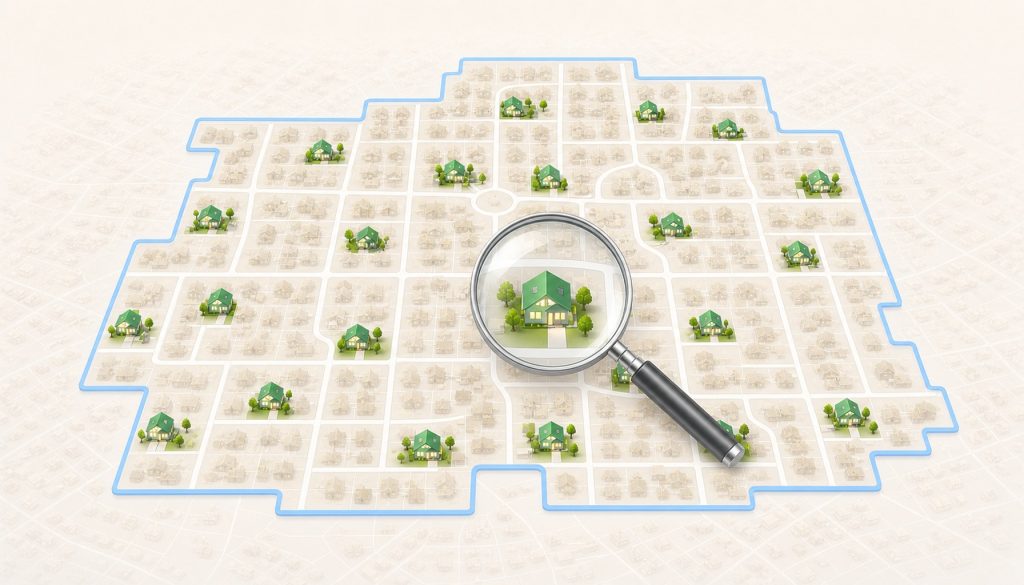
Key Takeaways
- A zip code is a container, not a strategy. The value comes from layering demographic or firmographic filters on top of the geographic boundary.
- Identify the right zip codes by analyzing your current customer base to find high-concentration areas, then look for adjacent zips with similar profiles.
- For B2B, filter by SIC/NAICS code, employee count, and executive title. For B2C, filter by homeowner status, estimated home value, age, and move date.
- Use EDDM saturation mail for broad-appeal offers (e.g., pizza delivery) and filtered compiled lists for targeted audiences (e.g., financial services for seniors).
- Before any mailing, run your list through NCOA (National Change of Address) processing to remove moved addresses and reduce wasted postage.
A home-services company mails 10,000 postcards to every address in three zip codes and sees an underwhelming response no better than untargeted saturation mail. The problem wasn’t the zip codes; the problem was that the zip code was the only filter. The list included renters, apartment complexes, and households with estimated incomes well below the service’s price point.
This is a common failure in local prospecting. Zip code marketing is not about choosing a geography and blasting it. It is about using the zip code as the first layer of a filtering stack then adding homeowner status, estimated home value, business SIC code, or executive title to turn a geographic boundary into a qualified audience.
A zip code is a container, not a strategy. The rest of this article explains how to fill that container with the right records, through the right channels, with the data hygiene and compliance practices that keep a campaign deliverable and effective.
What Zip Code Marketing Is and What It Is Not
Zip code marketing is the practice of selecting one or more five-digit U.S. postal codes as the geographic boundary for a prospecting or advertising campaign, then building or targeting an audience within those boundaries. With roughly 41,700 zip codes in the U.S., each containing anywhere from a few hundred to over 100,000 residents, the zip code itself is too broad to be a useful segment. Its value comes from the ability to layer other filters on top of it.
Practitioners often conflate it with three adjacent methods:
- Radius Targeting: This draws a circle from a central point (e.g., a 10-mile radius from a storefront). It’s useful for defining a service area but less precise for mail campaigns, as USPS carrier routes follow zip boundaries, not perfect circles.
- Geofencing: This uses GPS or IP signals to trigger mobile ads when a device enters a defined virtual perimeter. It operates in real time and is channel-specific to mobile advertising, not based on a compiled list of addresses or contacts.
- DMA or Metro-Level Targeting: Designated Market Areas (DMAs) are large media markets used for broadcast and wide-scale programmatic ad buys. They are far too broad for the direct mail, email, and calling campaigns where zip code targeting excels.
For example, a pest control company might use a compiled list to mail every single-family home in three zip codes. A financial advisor, however, would target those same zips but filter the list down to homeowners over 55 with estimated home values above $300,000. Same geography, entirely different strategies.
Read more: ZIP Code Mailing Lists – Buy Mailing Lists by ZIP Code from Infofree
How to Identify the Right Zip Codes for Your Campaign
Teams often pick zip codes based on proximity to their office or anecdotal knowledge of where their customers live. A data-driven approach is more reliable. It starts with analyzing your existing customer base to find where success is already happening, then finding more areas like them.
This is a practical form of trade area analysis. Export your current customer list with addresses, map it by zip code, and identify the 10-15 zips with the highest customer concentration. These are your core territories. The next step is to use demographic or firmographic data to find adjacent or similar zips that match the profile of your core territories but have lower customer penetration. This is where you find your expansion opportunities. For example, an insurance agency might discover 60% of its Medicare Supplement policyholders cluster in 12 zip codes, then use demographic overlays to find eight additional zips with similar age-65+ density and median income bands.
Selecting Zip Codes for B2B Campaigns
For B2B campaigns, zip code selection should be driven by business density and industry concentration, not just population. A zip code with 400 businesses in your target SIC code range is a better prospect pool than one with 4,000 residents but only 30 relevant businesses.
Evaluate potential zips based on:
- Number of businesses by SIC or NAICS code: Find zips with a high concentration of your target industries.
- Employee-count distribution: Look for zips with a high density of businesses in your ideal size range (e.g., 10–50 employees).
- New business formation: Target zips with a high rate of new business filings if you sell to startups.
Platforms like InfoFree, with its database of approximately 22 million U.S. businesses, allow you to run these counts and analyses directly, combining the selection and list-building steps in one workflow.
Selecting Zip Codes for B2C Campaigns
For B2C campaigns, zip code selection is about finding geographic areas with a high concentration of households that match your ideal buyer profile. Instead of relying on proximity, analyze zips based on key demographic and household attributes.
Look for zips with favorable concentrations of:
- Median Household Income: Aligns with your product or service’s price point.
- Homeownership Rate & Estimated Home Value: Critical for real estate, mortgage, and home services.
- Age Distribution: Essential for campaigns targeting seniors, young families, or other age-defined segments.
- Mover Density: Identifies areas with a high volume of new residents for mover campaigns.
Public data from the U.S. Census Bureau’s American Community Survey (ACS) can inform initial selection, while consumer databases let you validate the specific record counts in each zip before committing.
Building Filtered Prospect Lists Within Your Target Zip Codes
Once you have your target zip codes, the temptation is to pull every record and call it a list. This approach prioritizes volume over relevance and is the primary cause of low response rates. The step that separates a high-performing zip code campaign from a mediocre one is the filtering layer you apply inside each zip.
Think of it as a three-layer stack:
- Geographic Boundary: The zip code(s).
- Qualification Layer: Firmographic (B2B) or demographic (B2C) attributes.
- Deliverability Layer: Channel-specific contact info (mailing address, email, phone).
A contractor could pull all 8,200 records in a zip code. Or, that same contractor could filter for homeowners with estimated home values above $200,000 who moved in the last 90 days. The list shrinks to 340 highly relevant records, and the ROI on a kitchen-remodel mailer climbs accordingly.
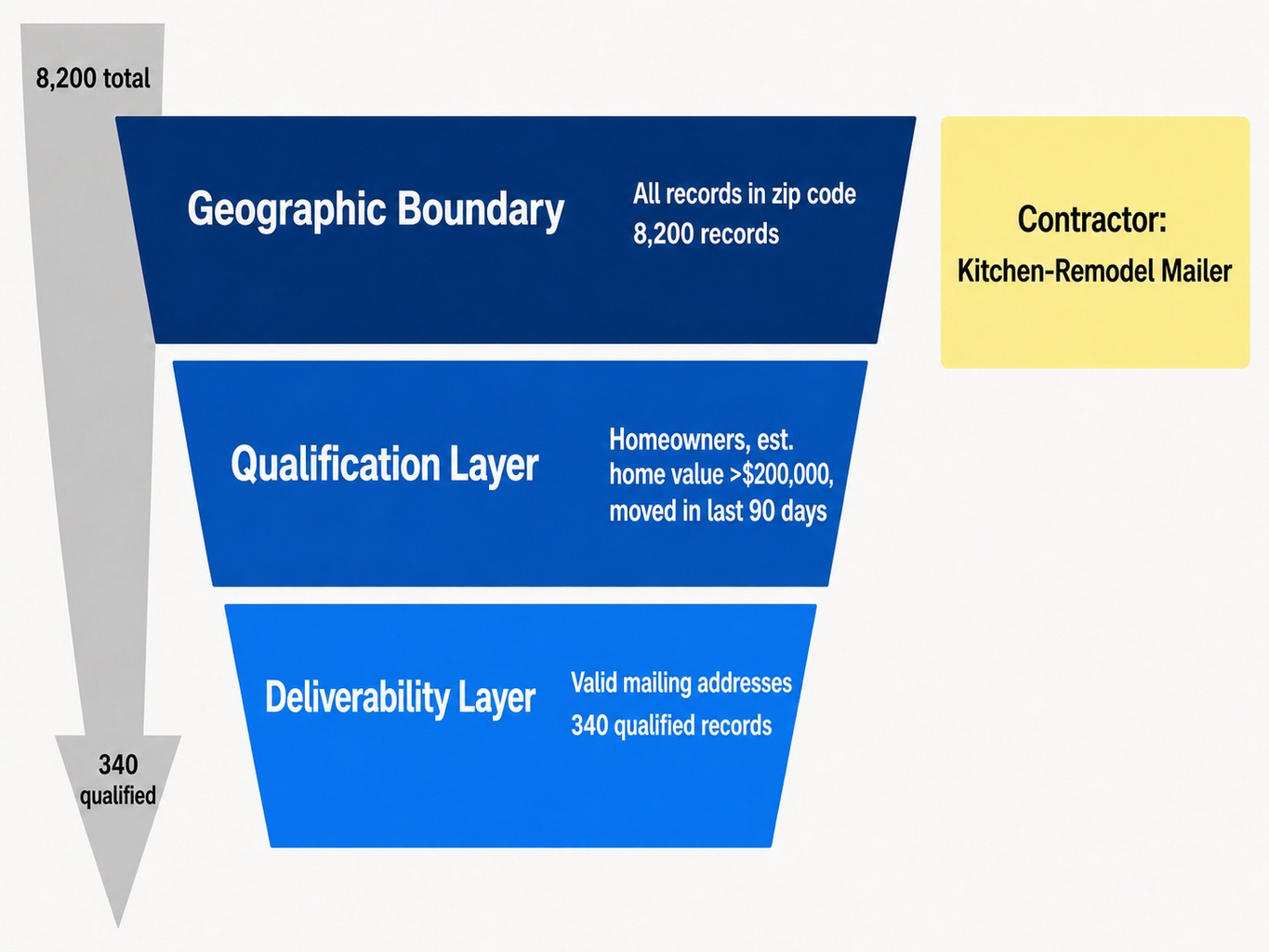
Layering filters inside a zip code transforms volume into a qualified prospect list.
B2B Filter Stack: Company and Executive Targeting by Zip Code
A typical B2B list-building workflow using a zip code filter follows a clear sequence.
- Start with Geography: Select one or more zip codes.
- Filter by Industry: Use SIC or NAICS codes to isolate your target verticals.
- Qualify by Size: Filter by employee count or estimated annual revenue to find companies that fit your ideal customer profile.
- Target the Decision-Maker: Filter by executive title (e.g., “VP of Marketing,” “Owner,” “Director of IT”) to ensure your message reaches the right person.
InfoFree’s business database, which is triple-verified and rated at 95% accuracy, supports this exact workflow. It is important to note this accuracy claim applies specifically to business data, not to consumer records. Building a list of decision makers by title ensures your outreach lands with the person who can actually approve a purchase.
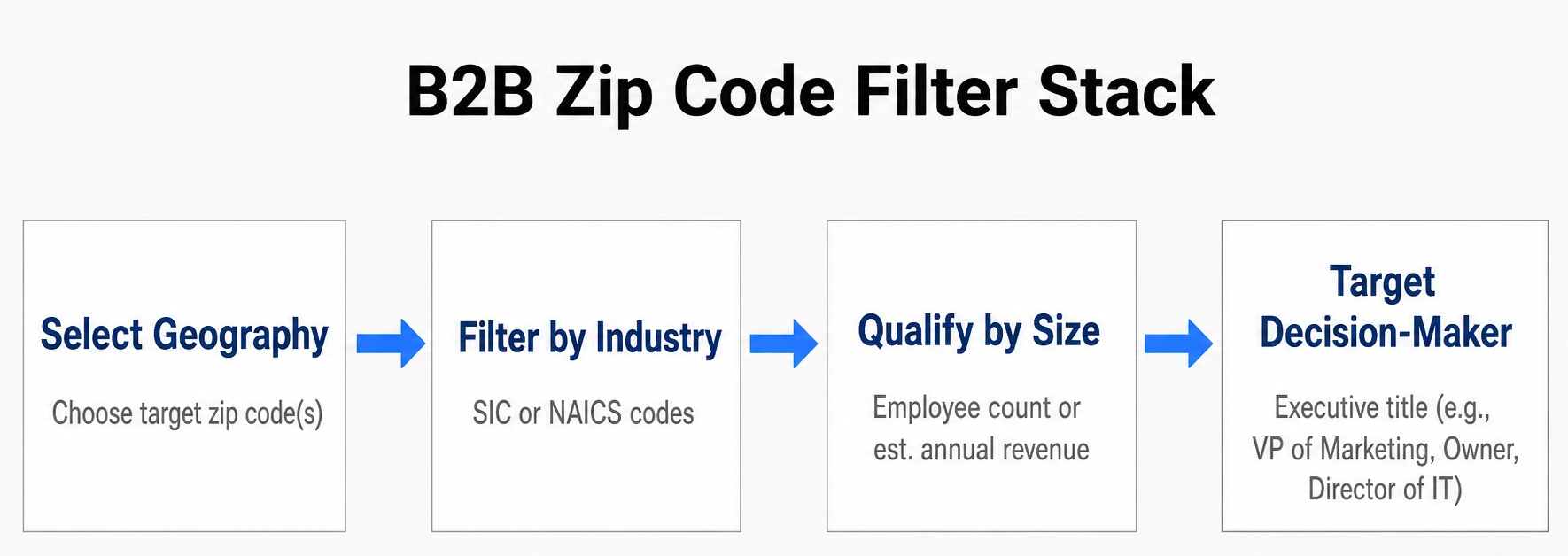
The B2B filter stack narrows zip code targeting to the right executive at the right company.
B2C Filter Stack: Consumer and Household Targeting by Zip Code
For B2C campaigns, the filtering logic shifts from company attributes to household and individual characteristics.
- Start with Geography: Select your target zip code(s).
- Filter by Household Status: Isolate homeowners, renters, or new movers.
- Qualify by Financial Indicators: Filter by estimated home value or estimated household income.
- Target by Demographics: Narrow by age range, presence of children, or other demographic markers.
- Time the Outreach: For new mover or new homeowner campaigns, filter by move date (e.g., last 30, 60, or 90 days).
When building lists for calling, emailing, or mailing, you are responsible for ensuring compliance with the DNC Registry, TCPA, CAN-SPAM, and applicable state privacy laws. Consumer and household records are compiled from a different set of public and private sources than business records and are not rated on the same 95% accuracy standard.
EDDM Saturation Mail vs. Compiled Zip Code Mailing Lists
Every Door Direct Mail (EDDM) and compiled mailing lists both use zip codes, but they serve different goals. Choosing the right one depends entirely on how much of the audience within a geography is a potential customer.
EDDM is a USPS service that delivers a mailpiece to every address on selected carrier routes within a zip code. No list purchase is needed, and pricing is low around $0.26 per piece for a standard flat. It’s ideal for businesses with broad appeal that want to blanket a local area: restaurants, retail stores, political campaigns, or a dentist’s office.
A compiled zip code mailing list lets you filter by demographic, household, or business attributes before you mail. You only pay for postage on records that match your target profile.
The trade-off is clear:
- EDDM: Cheaper per piece, simpler to execute, but reaches everyone, including non-prospects.
- Compiled List: Higher upfront data cost, but reduces waste and improves response rates by focusing spend on qualified households or businesses.
As a rule of thumb: if your product applies to more than 60–70% of households in a zip (e.g., pizza delivery), EDDM is likely more cost-effective. If your audience is a specific subset (e.g., homeowners over 60, businesses with 10+ employees), a filtered compiled list from a provider like InfoFree will almost always outperform saturation mail on cost-per-acquisition.
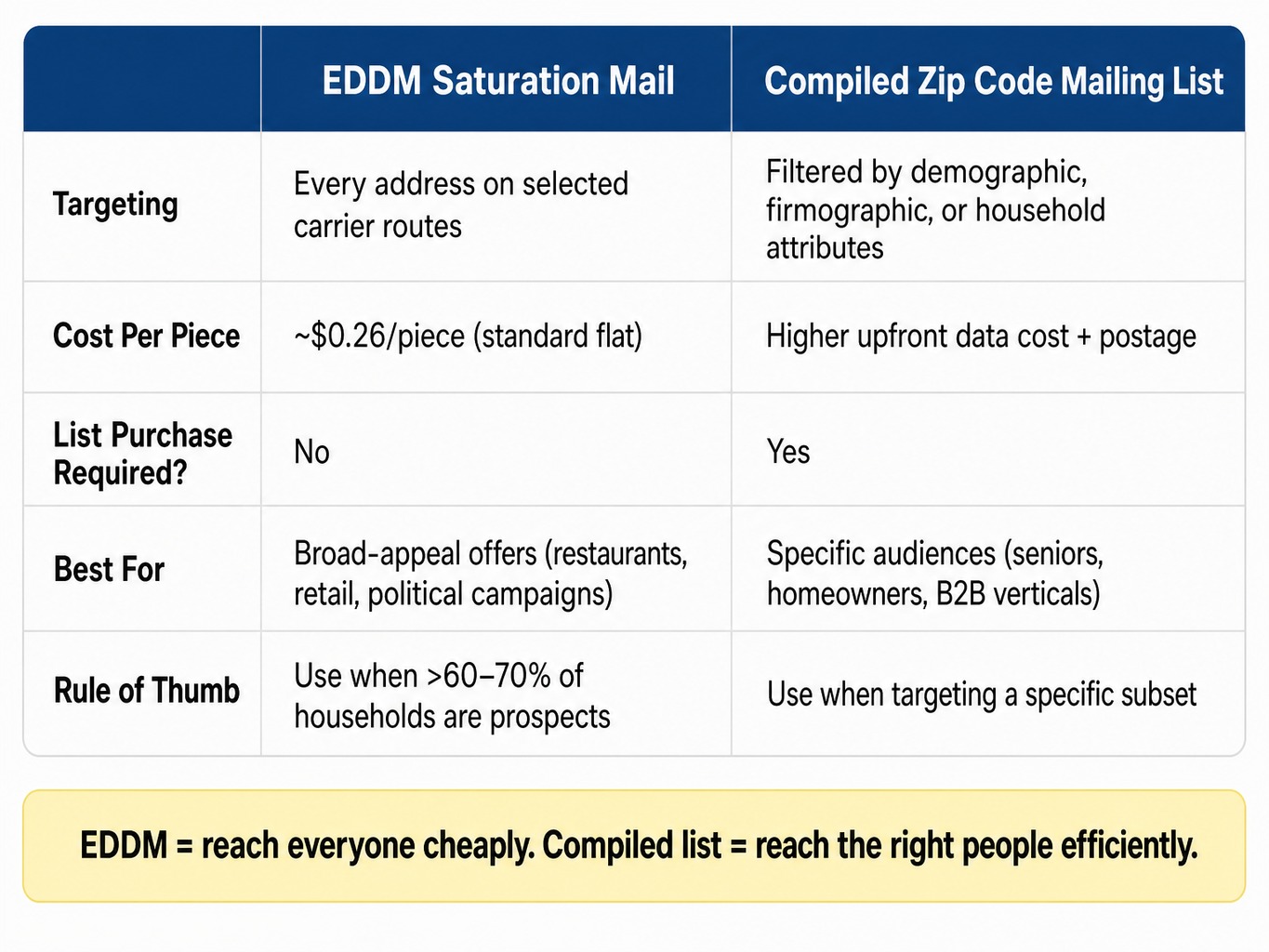
Choosing between EDDM and a compiled zip code mailing list depends on audience specificity.
Zip Code Targeting in Digital Advertising
Zip code targeting is not just for direct mail. Both Google Ads and Meta Ads support location targeting at the zip code level, though with important differences in mechanics and precision.
Google Ads allows you to add specific zip codes as location targets and layer demographic bid adjustments (age, gender, income tier) on top. However, this targeting is directional, not exact. It relies on a mix of IP address, device GPS signals, and user-reported location, which means a campaign “targeting” a zip code will inevitably serve some impressions to users physically outside it.
Meta Ads (Facebook/Instagram) also supports zip code targeting in its location settings, letting you narrow by age, interests, and behaviors. But for ads related to housing, credit, or employment, Meta’s Special Ad Categories rules apply, preventing granular demographic targeting and enforcing a minimum 15-mile radius around a selected point.
Neither platform offers the record-level precision of a compiled list. Digital zip code targeting controls ad delivery probability, not individual outreach. For an omnichannel campaign, this can be effective; a household that receives a mailer and sees a geo-targeted ad in the same week is more likely to respond.
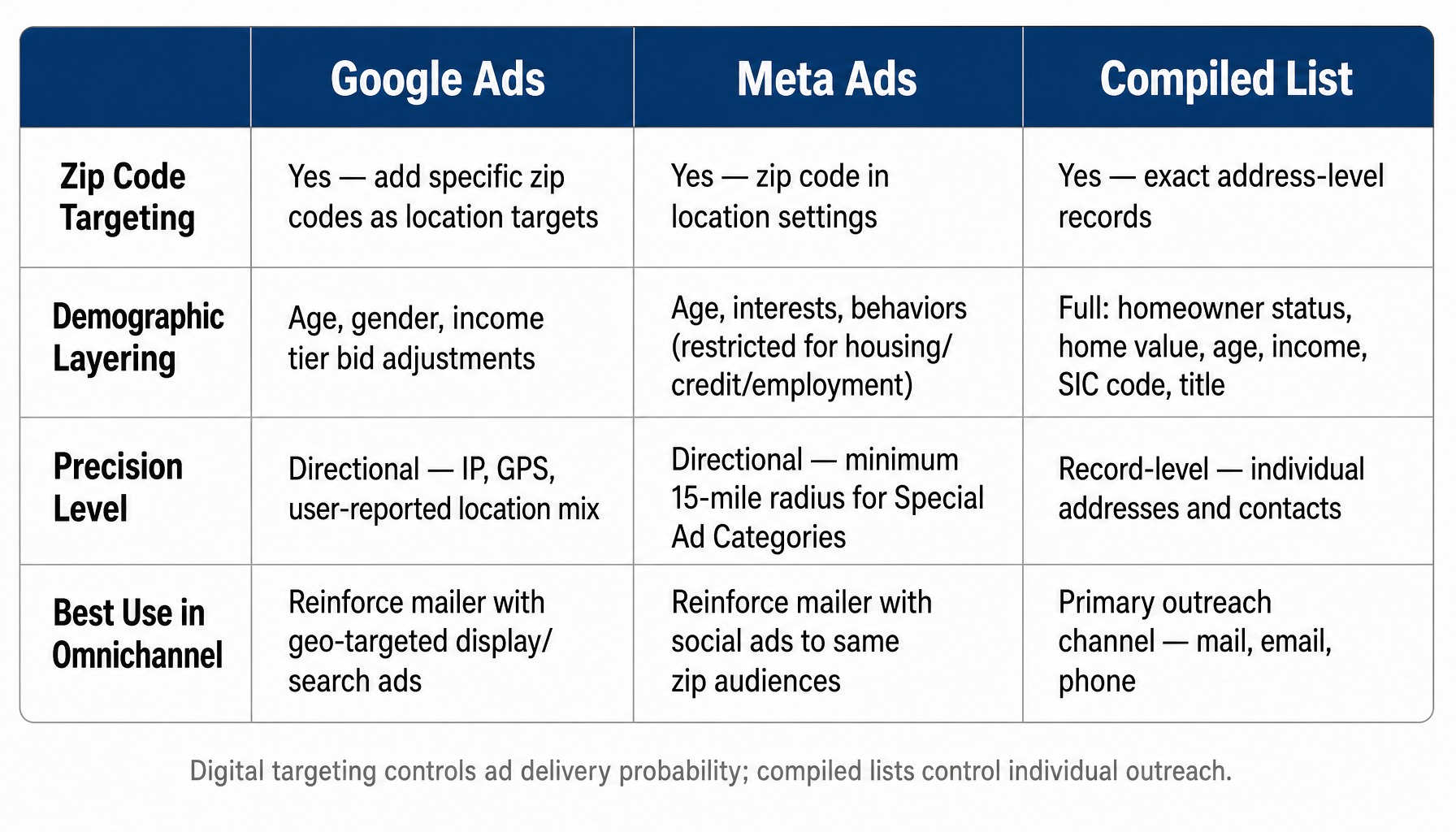
Digital zip code targeting is directional; compiled lists offer record-level precision.
Data Hygiene and Compliance for Zip Code Campaigns
A zip code mailing list that hasn’t been cleaned is a liability. According to the USPS, roughly 40 million Americans move each year, meaning any list older than 90 days will contain undeliverable addresses. Every piece mailed to one of those “nixie” records is wasted money. A list that hasn’t been run through NCOA in over a year can easily carry undeliverable rates in the high single digits, and the postage saved from cleaning it typically exceeds the cost of the hygiene pass itself.
A proper hygiene workflow has three steps:
- NCOA Processing: Match your list against the USPS National Change of Address database to update records for people who have filed a move within the last 48 months.
- CASS Certification: Standardize every address to conform to USPS delivery-point standards. This not only improves deliverability but also qualifies your mailing for postal presort discounts.
- Merge-Purge: Deduplicate records across multiple lists or within the same list to avoid mailing the same household or business twice.
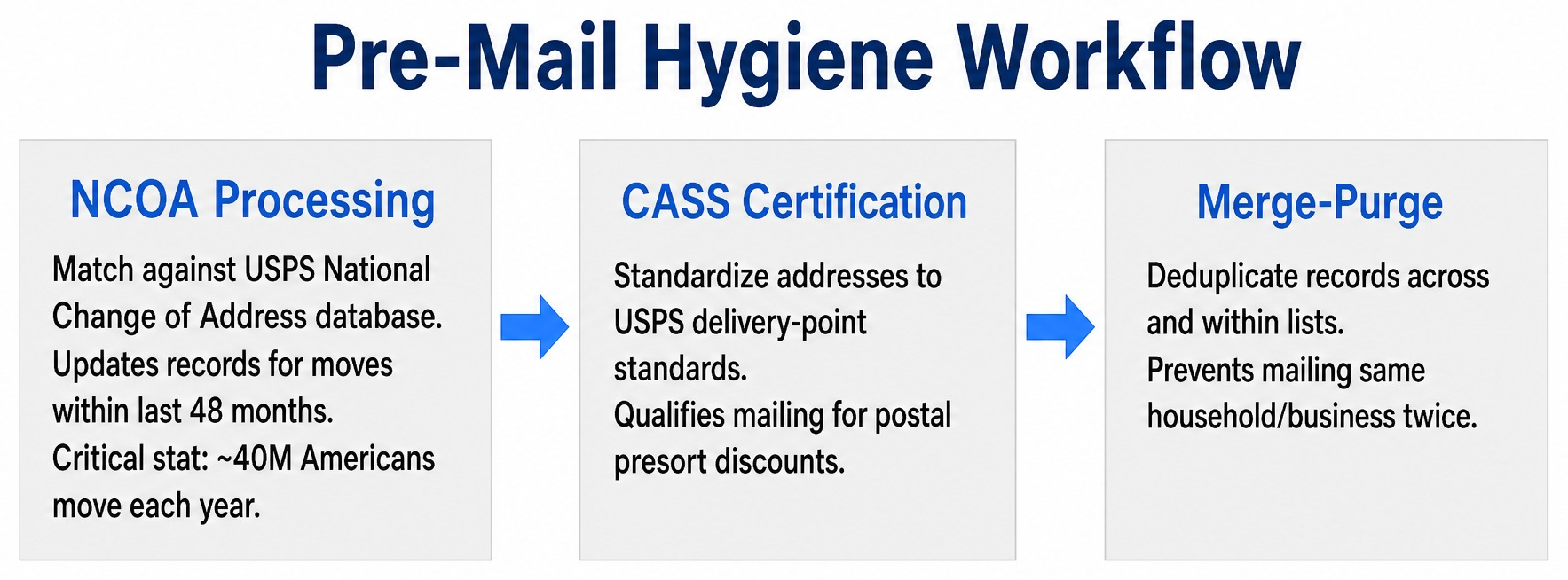
Run this hygiene workflow before every mail drop to protect your zip code campaign ROI.
Beyond hygiene, there is compliance. Any campaign involving phone calls must scrub against the federal Do Not Call (DNC) registry and comply with the Telephone Consumer Protection Act (TCPA). Email campaigns must follow CAN-SPAM rules. Furthermore, state-level privacy laws like the California Consumer Privacy Act (CCPA) impose additional obligations. The marketer, not the data provider, is ultimately responsible for ensuring all outreach is compliant.
How InfoFree Supports Zip Code List Building Across B2B and B2C
The central challenge of zip code marketing is turning a broad geographic area into a qualified audience. This requires layering the right filters, distinguishing between business and consumer records, and managing data hygiene all of which can feel fragmented across multiple tools.
InfoFree solves this by providing one platform where B2B and B2C list building happen in the same workflow.
- For B2B campaigns, users filter by zip code plus SIC code, employee count, and executive title across approximately 22 million business records rated at 95% accuracy.
- For B2C campaigns, users filter by zip code plus homeowner status, estimated home value, age band, and move date across approximately 270 million consumer records.
This unified approach lets you execute the specific filtering strategies discussed in this guide without switching systems. Unlimited search and view access is included at a flat subscription rate, with export limits that vary by plan. The included CRM101 also supports follow-up tracking for calls and emails, shortening the path from list building to outreach.
When using any exported data, customers are responsible for following all applicable local, state, and federal laws, including CAN-SPAM, TCPA, DNC rules, and state privacy statutes. InfoFree provides the data; it is not liable for how customers use it.
Your Zip Code Is Just the Starting Point
Zip code marketing is not a strategy in itself. It is a geographic starting point that becomes a strategy only when combined with the right filters, the right channel, and the right data hygiene. The value of a campaign is determined by what you layer on top of the zip code, not by the zip code alone.
Before your next campaign, take one simple action: map your current customers by zip code. Identify the 10-15 zips with the highest concentration, analyze their common attributes, and build your next filter stack from there. Stop buying geography and start building an audience.
Frequently Asked Questions
What is the difference between ZIP+4 targeting and five-digit zip code targeting for marketing campaigns?
ZIP+4 codes narrow a five-digit zip to a specific delivery segment typically 10-20 addresses on one side of a street. They are essential for postal sorting and delivery-point validation (DPV) but are too granular for audience selection in most prospecting platforms. Use five-digit zips for campaign targeting and let CASS certification software assign the ZIP+4 during mail preparation.
How often should I refresh a zip code mailing list before re-mailing the same area?
Run NCOA processing before every mail drop if the list is older than 90 days. For time-sensitive campaigns targeting new movers or new homeowners, refresh monthly. A mover record loses most of its value within 30-60 days as households lock in their local service providers. For stable homeowner or business lists, quarterly processing is a reasonable minimum.
Is it legal to buy an email list segmented by zip code?
Purchasing a compiled email list is legal in the U.S., but sending to it requires strict CAN-SPAM compliance, including a valid physical address, a working unsubscribe link, and non-deceptive subject lines. State privacy laws may add further rules. Purchased lists also tend to have higher bounce rates, which can damage your sender reputation over time.
What response rates should I expect from a zip code targeted direct mail campaign?
Response rates vary widely, but general industry benchmarks show targeted direct mail to a filtered list producing 1-5% response rates, while EDDM saturation mail often runs lower at 0.5-1.5%. The difference is the filtering; a list narrowed by homeowner status, income, or age reaches a more qualified audience and generates a higher response per piece mailed.
Can I layer income, age, or homeowner data on top of zip code targeting in digital ad platforms?
Yes, but with limitations. Google Ads allows demographic bid adjustments (age, gender, household income tier) on top of zip code targets. Meta Ads supports age and interest targeting but restricts demographic narrowing for housing, credit, and employment ads. Neither provides the same record-level precision as a compiled list; digital targeting controls ad delivery probability, not individual selection.