


Key Takeaways
- The value of pre-mover data depends on where the lead comes from, such as real estate listings or behavioral activity, how old the record is, and whether multiple signs back up that a household is likely to move, not just list size or cost per record.
- Pre-mover data decays rapidly, losing most of its outreach value within 14-21 days of the trigger event. Mail campaigns should be executed within 7-10 days of receiving a file.
- Providers use two main methods to identify pre-movers: high-confidence listing triggers (MLS, FSBO) and predictive behavioral signals. The method determines both lead time and accuracy.
- Before buying a list, audit the provider on their data sources, file build cadence, name-match rate, average record age, and suppression handling.
- The most effective pre-mover campaigns target verticals with immediate needs, such as home services, insurance, and telecom, where households must choose a new provider quickly.
Imagine a home services marketer buys a pre-mover mailing list of 10,000 records. They mail within two weeks and see a 1.8% response rate, which is a solid return. Six weeks later, they reorder the same list from the same provider and mail on the same schedule. This time, the response rate barely clears 0.6%. The list wasn’t bad; it was late.
This scenario is a common and expensive mistake in pre-mover marketing. The value of pre-mover data is determined almost entirely by three factors buyers must inspect before purchasing: how the provider identifies pre-movers, how old the records are when they reach you, and how many independent signals confirm each household’s intent.
A record that reaches you 45 days after the listing trigger is not stale data; it is a post-mover record with the wrong label. This guide provides a practitioner’s framework for evaluating pre-mover data providers, auditing list quality, and avoiding the trap of late data. We will cover what these records contain, how they are built, how fast they decay, and what to ask before you commit.
As with any consumer outreach, using pre-mover data for mail, email, or phone campaigns requires the marketer to comply with all applicable DNC, TCPA, CAN-SPAM, and state privacy laws.
What Pre-Mover Data Actually Contains and What It Does Not
Pre-mover data identifies individuals or households that show signals of an upcoming move but have not yet changed their address. This is fundamentally different from new-mover data, which captures records after a move is completed and is typically sourced from confirmed address changes like the USPS National Change of Address (NCOA) file or new utility connections, often identified as PCOAs Personal Change of Address signals. It’s a critical distinction; any provider using NCOA as a primary pre-mover source is actually selling post-mover data under a different name.
Pre-mover records are predictive, not confirmed. They are built from propensity models and trigger signals, not from address-change filings. A typical record in a pre mover mailing list file includes:
- Property Information: Current address, listing date, listing price, and property attributes (bedrooms, bathrooms, square footage, dwelling type).
- Consumer Data (when matched): Name, phone number, email address, estimated income, age, and homeowner status.
The match rate for appending consumer-level fields varies by provider and source. It’s common to see a name-match rate of 55–70% on listing-sourced records. This is a crucial metric to ask about, as it determines how many records are actionable for personalized mail, phone, or email outreach.
One common misconception is that pre-mover data includes the future address. It does not. The household has not moved yet, so the future address is unknown. The value of the data lies in reaching the household at their current residence while they are making purchasing decisions for their new one.
Read more: New Mover Lists – Email and Mailing Lead Lists from Infofree
How Providers Identify Pre-Movers and Why the Method Matters
Not all pre-mover data is built the same way, and the sourcing method determines both accuracy and the available lead time for your campaign. Most providers use one of two broad categories for identification: listing-based triggers or behavioral propensity signals. A smaller number aggregate both. Understanding which method a provider uses is the single most important question a buyer can ask, because it determines how far in advance a record appears and how confident the prediction is.
For example, a provider that sources only from MLS listing feeds will see a household when it lists its home, typically 30–60 days before the move. In contrast, a provider that layers in behavioral signals like home-valuation searches or moving-supply purchases may flag that same household two to four months before a listing ever appears. When a broader consumer database bundles pre-mover records alongside general demographic data without surfacing the sourcing method, the buyer has no way to distinguish a seven-day-old intent signal from a sixty-day-old public record, and the campaign economics collapse.
Listing-Based Triggers: MLS Feeds, FSBO Files, and Deed Filings
The most common source for pre-mover leads is real estate listing activity. This includes feeds from the Multiple Listing Service (MLS), For-Sale-By-Owner (FSBO) databases, and public deed filings. These are high-confidence signals; the property is verifiably on the market.
The trade-off is lead time. By the time a home hits the MLS, the household is often just 30–60 days from moving, which compresses the outreach window for marketers. These sources provide concrete data points like the listing date, listing price, and detailed property attributes. However, records sourced from FSBO sites can have lower name-match rates because they often bypass the consumer data ecosystem connected to the MLS. For marketers, listing-based data is reliable but requires a fast, disciplined outreach cadence to be effective.
Behavioral and Propensity Signals: Predicting Intent Before the Listing
A second, more predictive category of pre-mover data uses behavioral and propensity modeling. These models analyze signals like:
- Home-valuation website activity
- Mortgage pre-qualification inquiries
- Moving-supply e-commerce purchases
- Utility pre-connect requests
- Changes in insurance quoting behavior
These signals can flag a household’s intent to move two to four months before a listing appears, giving marketers a much longer outreach window. The trade-off is accuracy. Propensity models, by nature, produce more false positives than confirmed listing triggers. Their reliability depends heavily on model vintage the age of the model itself. A propensity model trained on 2019 housing market patterns will misfire in a 2026 market with different inventory levels and interest rate conditions. When evaluating a provider that uses propensity scoring, always ask when the model was last retrained.
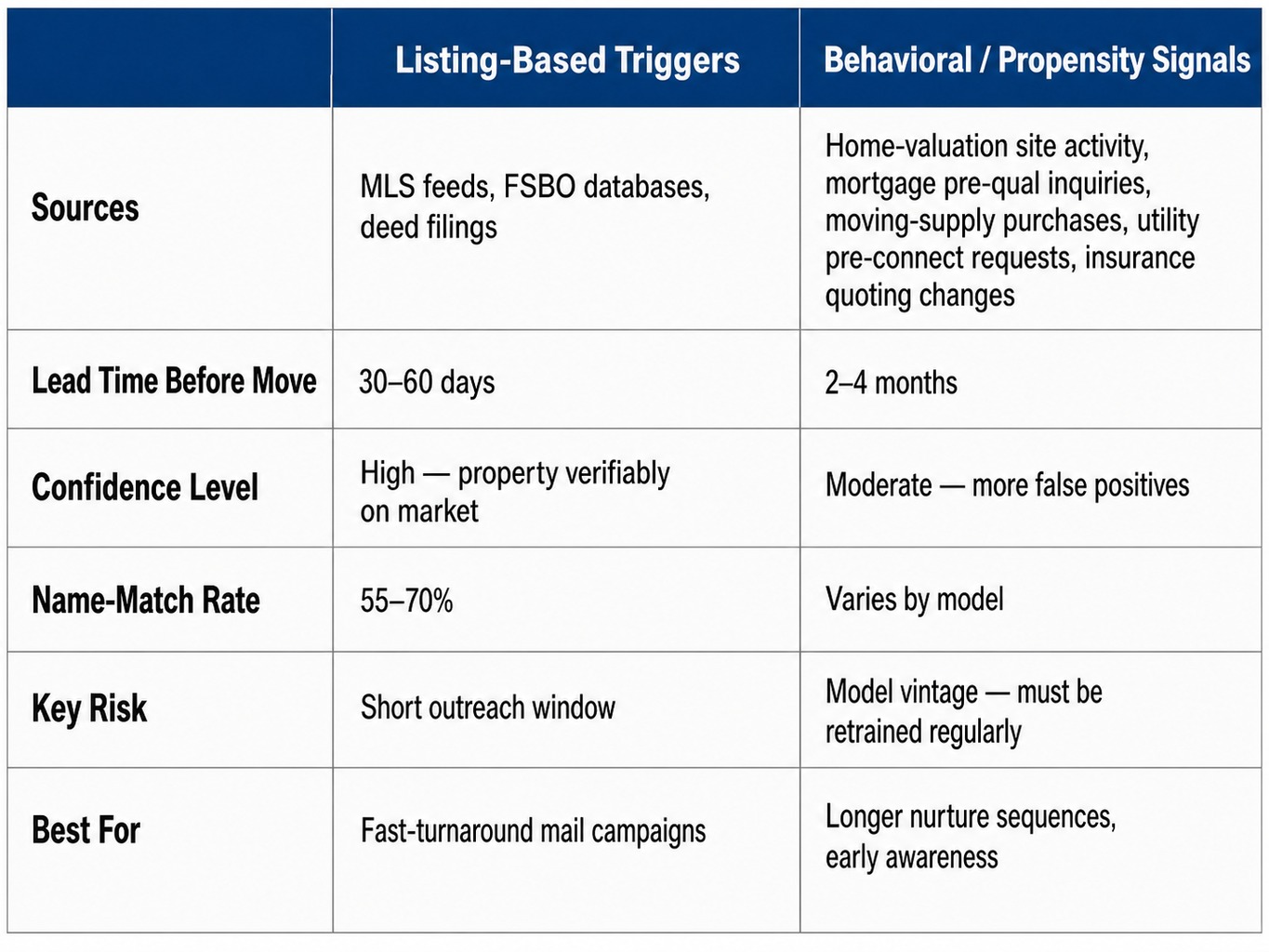
How your provider identifies pre-movers determines both lead time and accuracy.
The Deliverability Decay Curve: Why Timing Determines ROI
Pre-mover data loses most of its outreach value within 14-21 days of the triggering event. By day 45-60, the household has typically selected its local service providers, from moving companies to internet providers and insurance agents. Consider a side-by-side test: two pre-mover segments mailed for an HVAC campaign, one within seven days of the trigger and the other at day 28. The first segment typically pulls measurably higher response on every metric, while the day-28 segment often performs closer to a cold homeowner list with no mover signal at all.
This decay curve has direct implications for campaign ROI and how often you should refresh your prospect file. Industry practitioners commonly observe that responsiveness to pre-mover marketing can decline by 30-40% each week after the trigger event, though the exact rate varies by vertical and channel. This means a list that is four weeks old is potentially worth less than half of what a fresh list is.
The operational rule is clear:
- For direct mail: Request weekly or bi-weekly file drops from your provider and mail within 7-10 days of receipt.
- For pre-mover email data or phone outreach: The window is even tighter. Act within the first 3-5 days, as digital channels are crowded with competitors hitting the same household.
Any email or phone outreach must be executed in compliance with CAN-SPAM, TCPA, DNC registry rules, and applicable state privacy laws.
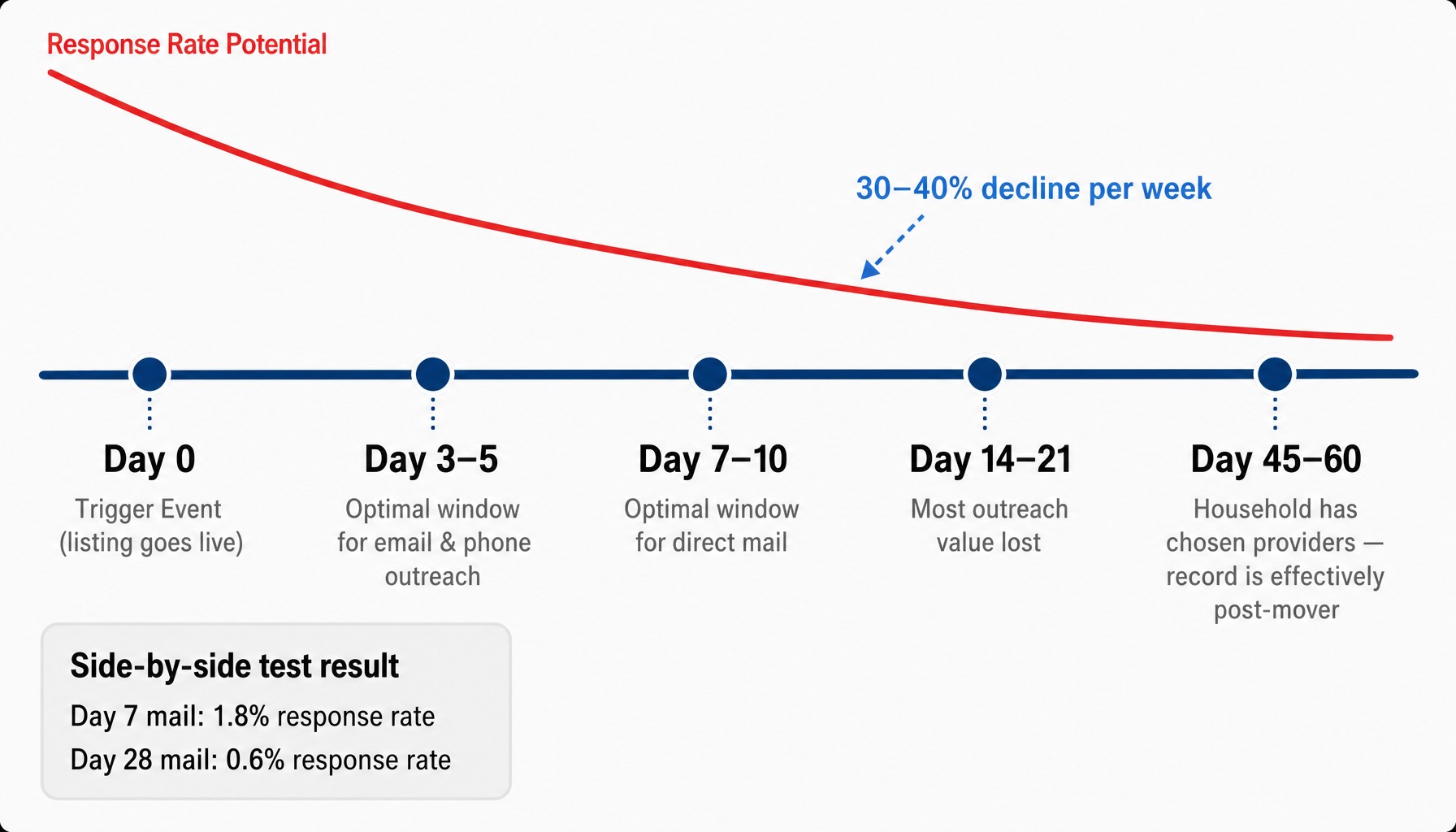
Pre-mover data loses 30–40% of its outreach value each week after the trigger event.
How to Audit a Pre-Mover Data Provider Before You Buy
For many buyers it seems to make sense to evaluate pre-mover data providers on price and record count, but actually those are the two least predictive indicators of campaign performance. The questions that actually forecast ROI are about signal diversity, refresh cadence, match rates, and suppression handling.
Use this checklist in your next provider conversation to separate data compilers from data resellers. If a provider cannot answer these questions with specific numbers, they are likely reselling someone else’s file.
Questions About Data Quality and Freshness
- How many independent signal sources feed your pre-mover file? Is it a single-source MLS feed or a multi-source aggregation of listing, behavioral, and public records? More diverse signals produce more reliable intent scoring.
- What is your file build cadence? Providers who build weekly or bi-weekly deliver fresher, more valuable data than those who update monthly.
- What is the average age of a record at the time I receive it? The answer should be in days, not weeks. A provider should be able to tell you the time between the trigger event and file delivery.
- Do you offer hot leads? These are records added since the last full file build, representing the absolute freshest leads.
Questions About Compliance, Suppression, and Contract Terms
- Is the file CASS-certified and NCOA-processed before delivery? This is a baseline standard for mail deliverability and address hygiene, confirming addresses are valid according to the USPS.
- Can I run a suppression merge-purge against my existing customer file? You should not have to pay for records of customers you already have. A good provider will support pre-delivery suppression.
- Does the contract include auto-renewal, and what is the cancellation window? This is a common pain point. Understand the terms before you sign an annual agreement.
- What is the deliverability expectation?
- For pre-mover email data, what is the opt-in basis? While CAN-SPAM doesn’t require opt-in for initial contact, understanding the source (compiled vs. responsive) helps manage deliverability risk.
Ultimately, all compliance obligations DNC, TCPA, CAN-SPAM, and state-level privacy laws rest with you, the marketer, regardless of what a contract says.
Pre-Mover Data Beyond Real Estate: Verticals Most Buyers Overlook
While moving companies and real estate agents are the most obvious users of pre-mover leads, the highest-ROI verticals are often in home services, insurance, and telecom. These are categories where a household must choose a new provider and has not yet formed a preference.
The key is the purchase cycle length. Pre-mover data works best for decisions made within the first few weeks of settling in.
- Immediate-Need Services: HVAC, pest control, landscaping, and cleaning services see high response within 14 days of the move. The need is urgent and the decision is fast.
- Insurance: Homeowner and auto insurance policies must be transferred or replaced. This shopping behavior often starts 2-4 weeks before the move, creating a prime window for competitive quotes.
- Internet, Cable, and Security: These are utility-like services where a choice is mandatory. Utility pre-connect requests are a powerful pre-mover signal, opening a 7-10 day window for outreach.
- Senior Care & Medicare: When a mover is 60+ and relocating, it often triggers a need to find new doctors, specialists, or Medicare supplement plans. Layering demographic filters like age onto pre-mover data can create highly targeted T65 campaigns.
In contrast, pre-mover data works less well for long-cycle categories like roofing or major remodeling, where the household is not yet thinking about capital improvements. For marketers building outreach lists across these verticals, homeowner lead lists filtered by move signals can sharpen targeting significantly.
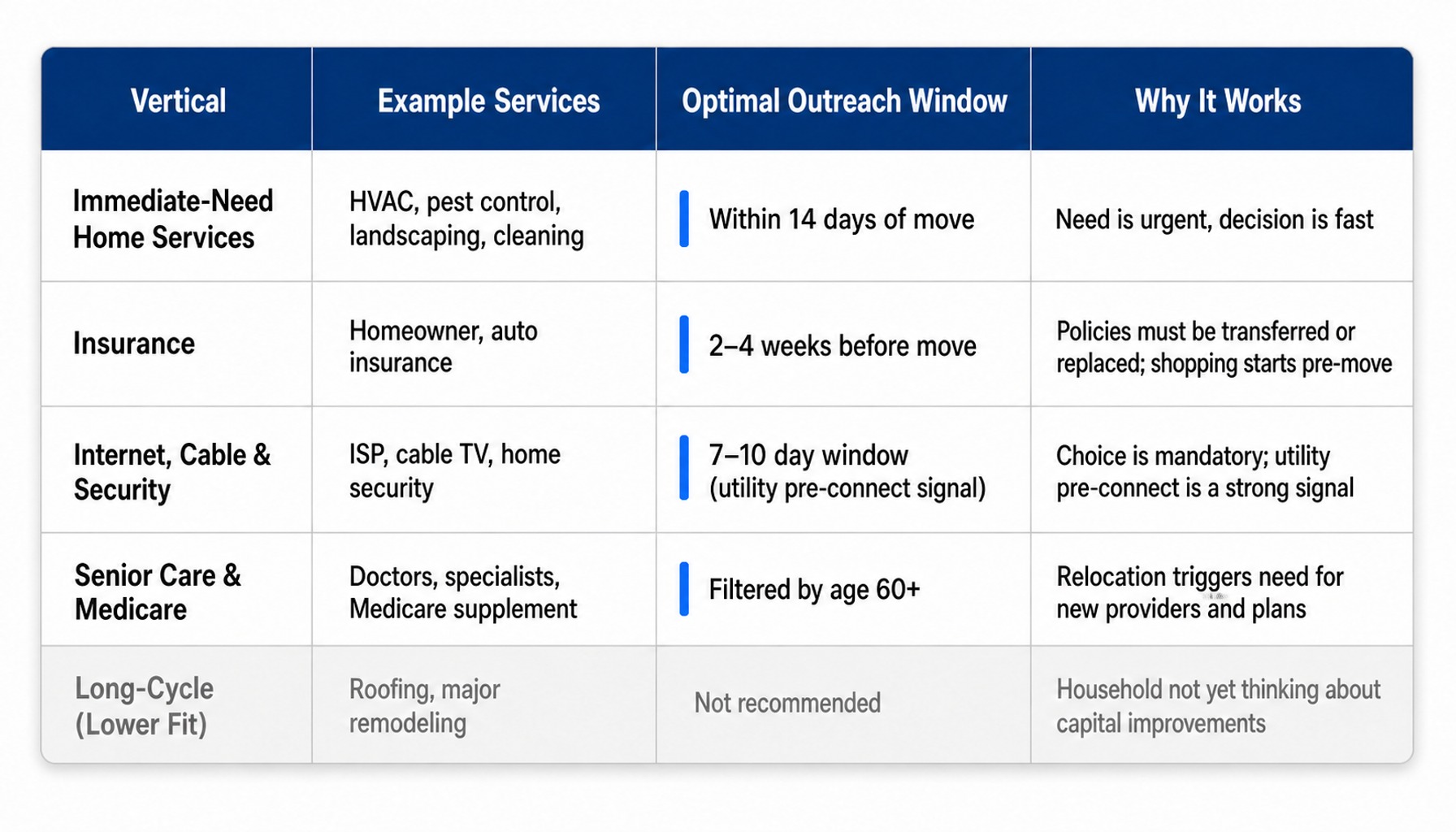
The highest-ROI pre mover leads target verticals with immediate, mandatory needs.
Inspecting Pre-Mover Records Before You Commit to Exports
The central tension in buying pre-mover data is that most providers require you to purchase a list before you can see what is in it. You are asked to trust claims about match rates, freshness, and signal diversity without inspecting the actual records.
InfoFree’s platform resolves this tension. It offers unlimited search and view across its consumer and household database, which covers approximately 270 million consumers and 170 million households. A marketer can build a pre-mover mailing list using filters like homeowner status, move date, geography, estimated home value, age, and other demographic attributes. You can inspect the records that match your criteria and then decide whether to export them.
This is not a blind list purchase; it is a search-first workflow where you see the data before committing exports, which are governed by plan-level limits. It is the practical answer to the audit framework laid out in this guide. Instead of asking a provider five questions and hoping for accurate answers, you can inspect the records directly. InfoFree also provides access to broader sales leads lists covering both business and consumer segments, giving marketers a single platform for multi-audience campaigns.
Search pre-mover records by homeowner status, move date, and geography inspect before you export
Conclusion
The most important shift for any buyer of pre-mover data is realizing that quality is not about list size. It is about signal diversity, model vintage, and how fast the records reach you. The difference between a 1.8% response rate and a 0.5% response on the same list type usually comes down to record age and the number of independent signals confirming intent.
Buyers who audit their provider on these dimensions and who can inspect records before committing to a purchase avoid the most common and expensive mistakes in pre-mover marketing. As state-level privacy laws expand and consumer data regulations tighten, the providers who can demonstrate their sourcing methodology and suppression practices will separate from those who cannot.
Frequently Asked Questions
What is propensity-to-move scoring and how reliable is it?
Propensity-to-move scoring uses behavioral and demographic variables such as length of residence, home equity, age, and online activity to predict the likelihood a household will list its home. Reliability depends on model vintage; a model trained on recent housing data in your geography will outperform a national model built on older patterns. Ask the provider when the model was last retrained.
What minimum list size do I need for a statistically meaningful pre-mover mail test?
For direct mail, a common rule of thumb is 2,000-5,000 records per test cell to detect a response-rate difference of 0.5% or more with reasonable confidence. If you are testing two offers against each other, you would need 4,000-10,000 total records. Smaller tests can still generate leads, but the results will not be statistically reliable for determining a winner.
How does pre-mover data compare to mortgage trigger leads for home services marketing?
Mortgage trigger leads are generated when a consumer’s credit is pulled for a mortgage inquiry, which typically happens after a purchase contract is signed. Pre-mover data from listing sources captures the household earlier, at the point of listing. For home services, pre-mover data reaches the household while it is still making provider decisions for the new home.
How do I suppress current customers from a pre-mover leads file?
Run a merge-purge before mailing by matching your customer file against the pre-mover file on name and address. Most list providers and mail-service bureaus can run this suppression for you. Ask the provider if they support pre-delivery suppression so you are not paying for records you will discard.
Are pre-mover mailing lists subject to state-level privacy regulations beyond federal law?
Yes. States like California (CCPA/CPRA), Virginia (VCDPA), Colorado (CPA), and others have enacted consumer privacy laws affecting how you use consumer data. Some require opt-out mechanisms or data-broker registration. Compliance obligations vary, so consult legal counsel for your specific markets and ask your provider if they are registered as a data broker where required.