

Key Takeaways
- In B2B direct mail, the mailing list is the campaign. Targeting precision by industry, company size, and executive title matters more than creative or format.
- Use direct mail to reach high-value accounts, senior decision-makers with gatekept inboxes, or to re-engage accounts that have gone dark on email. Use email for high-volume, low-cost outreach and rapid testing.
- Build your list using firmographic filters (SIC code, employee count, geography) and contact-level filters (verified executive title, role) to ensure your mailer reaches a person with buying authority.
- Trigger sends based on events like new-business filings, intent data signals, or as an escalation for unengaged email prospects. Timing is a critical advantage.
- Match the format to the goal. Postcards ($0.50-$1.50/piece) work for awareness, letters ($1.50-$3.00/piece) for outreach, and dimensional mailers ($5-$25+/piece) for high-value Account-Based Marketing (ABM) targets.
A B2B direct mail piece sent to the right VP of Operations at a 50-person manufacturing company will outperform a beautifully designed dimensional mailer sent to a generic purchased list. It will do so by a wide margin. A direct mail campaign targeting 5,000 businesses at a cost of $3 to $5 per piece means $15,000 to $25,000 is committed before a single reply arrives. If that list contains outdated addresses or inferred titles instead of verified contacts, that spend is unrecoverable in a way a failed email blast never is.
In B2B direct mail, the list is the campaign. The mailer, the copy, and the format are all critical, but they are downstream of a single decision: are you reaching the right companies and the right people within them?
Targeting is the foundation of B2B direct mail success. Before you think about creative, format, or cadence, you need to know which companies belong on the list and which people inside those companies should receive the piece. This article covers why physical mail still earns attention, when to use it instead of email, how to build a mailing list filtered by firmographics and role, what triggers should prompt a send, and what different formats cost.
Why B2B Direct Mail Still Earns Attention in 2025
The primary advantage of B2B direct mail is not nostalgia; it is channel scarcity. B2B professionals now handle roughly 120 emails per day on average, and cold outreach is a constant battle against inbox filters and digital fatigue. While a respectable cold email campaign might see a 1–3% click-through rate, B2B direct mail response rates commonly land in the 2.5–5% range, depending on list quality and format.
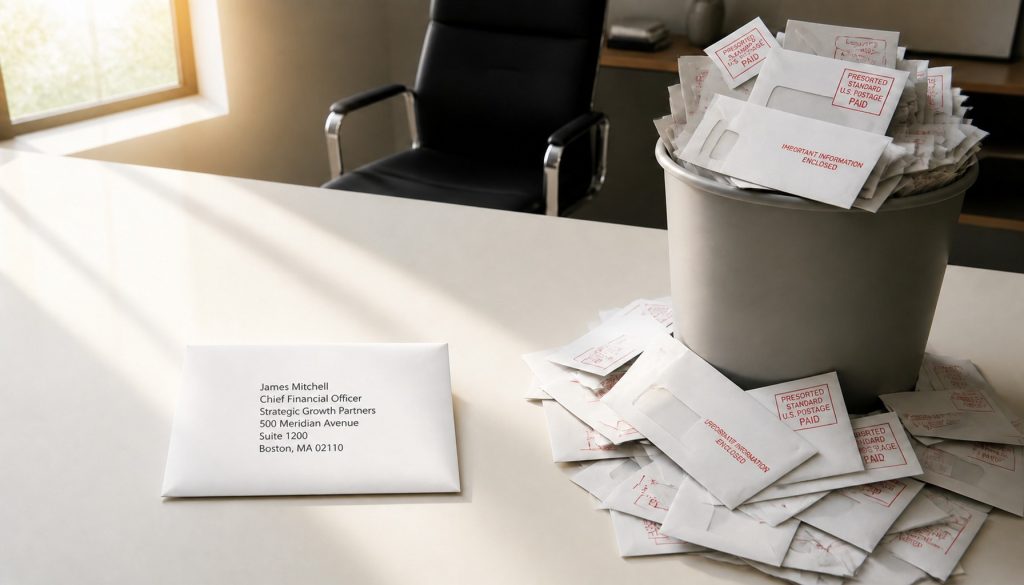
That difference is driven by attention. An email lands in a folder with 40 other vendor pitches. A well-targeted letter sits on a desk. The physical object earns a few seconds of consideration that the email never gets.
Consider a side-by-side test: the same oversized postcard mailed to two lists targeting CFOs at mid-market manufacturing firms. One list is built from a compiled database, filtered by SIC code, revenue band, and verified executive titles. The other is a pre-packaged “manufacturing decision-maker” list from a broker. In a scenario like this, the compiled list can produce a 4.1% response rate, while the broker list comes back with a 9% undeliverable rate before response can even be measured, because it’s padded with stale addresses and inferred titles. The mailer is identical; the list determines the outcome.
This advantage comes with a trade-off. Direct mail costs more per impression and takes longer to execute. It only justifies that cost when the list is precise enough to eliminate waste.
When to Use Direct Mail vs. Email in B2B and When Not To
The choice between direct mail and email is not about which is “better.” It is a decision based on the value of the account, the accessibility of the contact, and the stage of the relationship. B2B direct mail typically runs $1.50 to $5.00 or more per piece, while an email costs a fraction of that. The right channel is the one that aligns with that economic reality.
Many B2B teams that use direct mail effectively treat it as an escalation within a multichannel sequence, not as a standalone channel. A common pattern is email first for qualification, then direct mail for high-value accounts that engage or that go dark.
Conditions Where Direct Mail Outperforms Email
Physical mail earns its keep when you need to break through digital noise to reach a high-value contact. It works best under four conditions:
- Targeting Senior Decision-Makers: C-suite executives and VPs often have gatekept inboxes managed by assistants. A physical package or letter addressed to them by name has a higher probability of reaching their desk than an email from an unknown sender.
- Executing Account-Based Marketing (ABM): For target accounts where the potential deal value is high (e.g., $50k+ ACV), spending $5 to $25 per touch on a dimensional mailer is a justifiable expense to create a memorable impression with the buying committee.
- Re-Engaging Dark Accounts: When a high-potential prospect stops opening your emails, a physical mail piece can restart the conversation. It shows a level of investment that another automated email cannot.
- Navigating Regulated Industries: In sectors like financial services, insurance, or healthcare, strict email compliance and deliverability hurdles can make physical mail a more reliable and straightforward channel for official communications or high-stakes outreach.
Read more: Decision Maker Lists – Email, Phone and Mailing Lists from Infofree
When Email Is the Better Channel
Direct mail is the wrong tool when speed and scale are the primary goals. Email remains the superior choice for:
- High-Volume Prospecting: At the top of the funnel, when you need to contact thousands of potential leads at a low cost per touch to gauge interest, email is the only economically viable channel.
- Time-Sensitive Campaigns: For event invitations, webinar reminders, or limited-time offers, the 5-10 day delivery window for standard mail is too slow. Email provides the immediacy required for these campaigns.
- Early-Stage Qualification: Before you have confirmed an account fits your ideal customer profile (ICP), spending budget on physical mail is wasteful. Use low-cost email sequences to qualify fit first.
- Rapid Iteration and A/B Testing: You can test email subject lines, copy, and offers in a matter of hours and get immediate feedback. A/B testing a direct mail campaign takes weeks and significantly more budget.
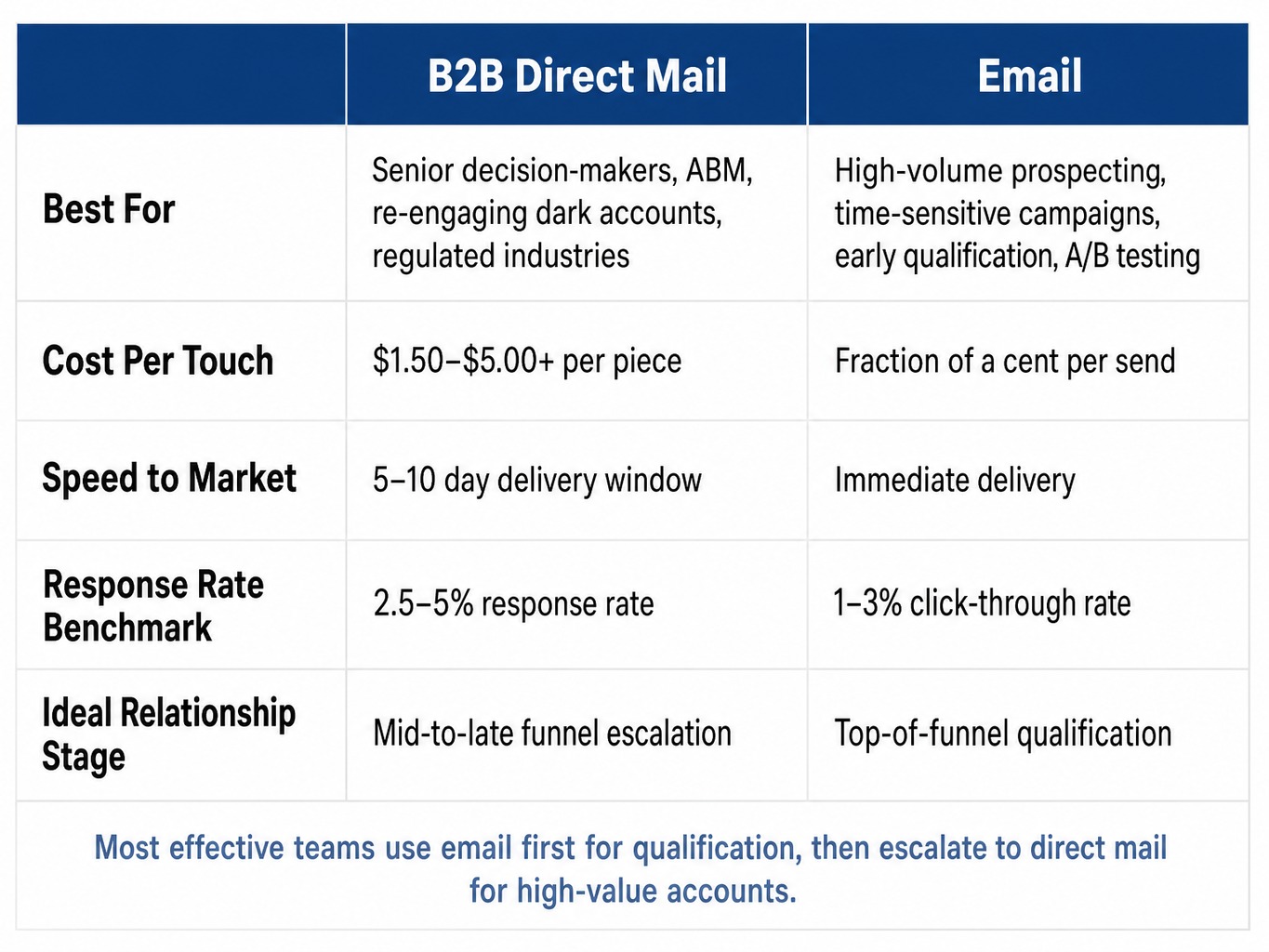
Direct mail vs email: choose the channel that matches account value and funnel stage.
How to Build a B2B Mailing List That Matches the Campaign
The single biggest variable in B2B direct mail ROI is not the creative, it is whether the list contains the right companies and the right people. A simple letter sent to 500 carefully filtered decision-makers will always outperform a dimensional mailer sent to 5,000 generic business addresses.
Quality has two dimensions. First is company-level targeting: reaching businesses that match your ICP by industry, size, and geography. Second is contact-level targeting: reaching the specific person who can act on your offer.
Consider an HVAC commercial services company targeting facility managers at manufacturing plants with 50-200 employees in a three-state region. The list build is the strategy. It requires filtering by SIC code for manufacturing, setting an employee count range, defining the geography, and then identifying contacts with titles like “Facility Manager” or “Director of Operations.”
Filtering by Firmographics: Industry, Size, Geography, and Company Age
Before you export any list, apply these four firmographic filters. Using our HVAC example:
- Industry: Start with SIC or NAICS codes to isolate manufacturing plants and exclude other commercial property types. This is the first and most important cut.
- Company Size: Filter by employee count (e.g., 50-200 employees) to match the service capacity of the HVAC company. Be aware that employee count on compiled databases often reflects the last verified snapshot, not real-time headcount; it is a directional filter, best used with another data point like revenue.
- Geography: Limit the list to a specific radius, metro area, or set of states that your business can realistically service.
- Company Age: Optionally, filter for newly established facilities using new-business formation data. These companies may not have locked in service contracts, making them more receptive to outreach.
The deliverability of this list depends on its hygiene. Ensure any list provider performs NCOA (National Change of Address) processing and CASS (Coding Accuracy Support System) certification. These USPS-approved processes clean addresses and reduce undeliverable mail.
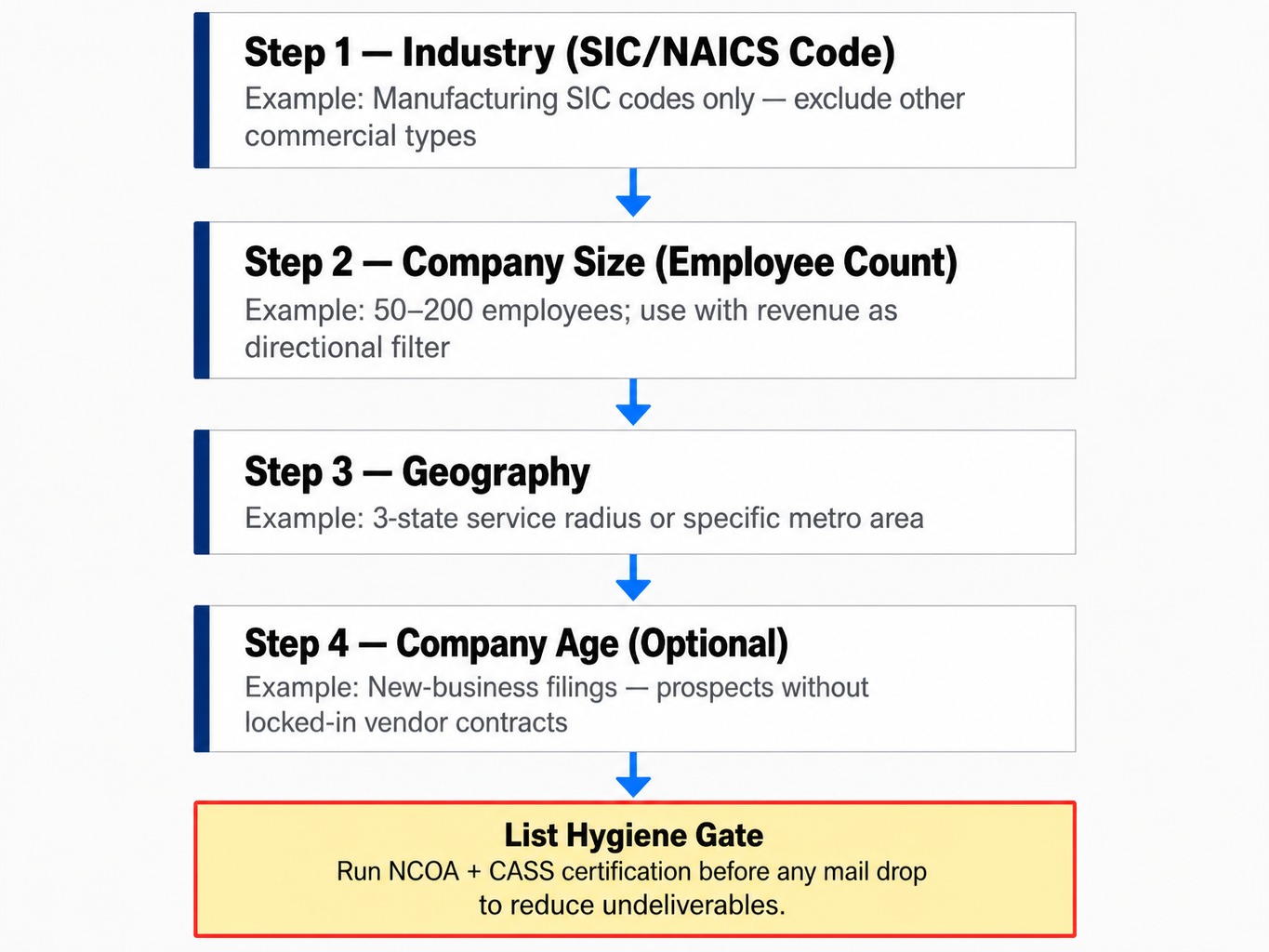
Four firmographic filters turn a raw database into a targeted B2B direct mail list.
Targeting by Executive Title and Role
Company-level targeting is necessary but not sufficient. The mailer must reach a named individual with buying authority.
This is where title-level filtering becomes critical. For the HVAC company, target titles might include “Facility Manager,” “Director of Operations,” “VP of Facilities,” or “Plant Manager.” A database that allows for title keyword searches is more flexible than one with rigid, pre-defined categories, as title conventions vary by company size. A 50-person manufacturer is unlikely to have a “VP of Facilities,” so the logic must account for equivalent roles.
A list with verified executive names and titles enables a personalized envelope addressed to a specific person, not a generic department. This is one of the strongest predictors of whether a B2B mail piece gets opened.
Finally, before any mail drop, run the list against a suppression file. This removes existing customers, active prospects in other sequences, and any contacts who have previously opted out. This step prevents wasted budget and maintains good data governance.
What Should Trigger a B2B Direct Mail Send
Typically, B2B direct mail is sent on a calendar schedule, quarterly campaigns, seasonal pushes. The highest-performing sends, however, are triggered by events that signal a prospect is actively in-market or ready for a new conversation.
- New-Business Formation: A company files incorporation paperwork in your service area. This is a prospect that needs to establish its initial vendor relationships. A commercial insurance broker, for example, can mail newly formed LLCs within 30 days of their filing date to be among the first to offer coverage. The timeliness of the data source is key; a record that is 90 days old has lost its advantage.
- Intent Data Signals: A target account begins researching your category on third-party sites. Intent data providers like Bombora or 6sense surface these signals, and a direct mail piece sent during this research window can break through the digital noise.
- Sequence Break Logic: A prospect has received 3-4 emails without engaging. Instead of sending a fifth email, the sequence logic automatically escalates to a physical mail piece. This changes the dynamic and can re-engage a cold lead.
- Role Change or New Hire: A new executive joins a target account. The first 90 days in a new role is a high-receptivity window, as leaders are often tasked with evaluating existing processes and vendors.
B2B Direct Mail Formats and What They Cost
The right format depends on the deal value and the relationship stage. Cost-per-piece is not the same as cost-per-response; a more expensive format can deliver a lower cost-per-meeting if it is well-targeted. Costs below are directional ranges and can vary with volume, print quality, and postage rates.
-
Postcards
- Cost: $0.50–$1.50 per piece.
- Use Case: Ideal for high-volume awareness campaigns, event invitations, or driving traffic to a URL via a QR code. The message is instantly visible, but there is little room for detailed copy.
-
Letters in Envelopes
- Cost: $1.50–$3.00 per piece.
- Use Case: The workhorse of B2B direct mail. A personalized letter addressed to a named executive can convey a specific offer, request a meeting, or provide value. It feels more formal and substantial than a postcard.
-
Dimensional Mailers (“Lumpy Mail”)
- Cost: $5–$25+ per piece.
- Use Case: Reserved for high-value ABM programs. A box containing a small gift, a branded item, or a clever physical object creates a memorable experience. The cost is only justified when the potential account value is significant.
-
Handwritten-Style Notes
- Cost: $3–$7 per piece (via automated services).
- Use Case: An effective middle ground for personalization. Use for following up after a demo, thanking a new customer, or reaching out to a C-level contact. It stands out for its personal touch without the high cost of a full dimensional kit.
When including a QR code or PURL (personalized URL) that captures prospect data, remember that the sender is responsible for following all applicable local, state, and federal privacy laws, including CCPA, GDPR where relevant, and state-level statutes.
Building the List: Where InfoFree Fits
This entire article argues that B2B direct mail outcomes are decided by list quality. The practical question is straightforward: where do you build a list with this level of precision without paying per record or depending on a broker with opaque data sources?
InfoFree was built to solve this problem. We are an original data compiler, building our business database in-house from thousands of sources and using a U.S.-based research team to triple-verify the records. Our business data is rated at 95% accuracy. The platform provides access to approximately 22 million U.S. businesses and up to 70 million executives, all searchable by the exact firmographic and contact-level filters this guide details: SIC/NAICS code, employee count, geography, executive title, and new-business formation date.
Our subscription model includes unlimited search and view access, so you can build, refine, and iterate on your list criteria without incurring per-record costs. Export limits vary by plan. For teams running B2B sales leads campaigns alongside consumer outreach, InfoFree provides access to a separate B2C household and resident database within the same platform. When using any exported data, customers are responsible for following all applicable local, state, and federal laws including CAN-SPAM, TCPA, DNC rules, and state privacy statutes where they apply. InfoFree provides the data; it is not liable for how customers use it.
Read more: Marketing Lists – Email and Mailing List Services from Infofree
Search InfoFree’s business and executive database to build your next B2B mailing list.
Your List Is Your Strategy
Physical mail earns a moment of attention because the channel is less crowded. But that attention is wasted if the list is not precisely filtered to the right companies and the right people within them. The format, the copy, and the timing all matter, but they are multipliers on list quality, not substitutes for it.
Before you design the next mailer, spend an hour building a list you would stake your budget on. Filter it by industry. Size it by employee count. Address it to a named decision-maker. That is where the ROI of your B2B direct mail campaign is truly decided.
Frequently Asked Questions
How long does it take to see pipeline results from a B2B direct mail campaign?
Direct mail has a longer feedback loop than email. The majority of responses arrive within 2-4 weeks of the drop date, but pipeline influence meetings booked, opportunities created may take 6-12 weeks to show up, depending on your sales cycle. Measure both initial response and downstream pipeline impact.
Can B2B direct mail sends be automated from a CRM?
Yes. Platforms like Sendoso, PFL, and Lob integrate with CRMs like Salesforce and HubSpot to trigger mail sends based on events like deal stage changes or lead score thresholds. The automation handles print and fulfillment, but the sender remains responsible for ensuring the list and outreach are compliant with all applicable laws.
What attribution model works best for tracking B2B direct mail influence?
A multi-touch attribution model is most practical. Use unique QR codes, PURLs, or dedicated phone numbers on each mail piece to track direct responses. For indirect influence, compare pipeline velocity and close rates for accounts that received mail versus a holdout group that did not. A matchback analysis, which matches closed deals back to the original mailing list, is also a common method.
How do you handle address verification for B2B mail at scale?
Before any mail drop, every list should be run through NCOA (National Change of Address) processing and CASS (Coding Accuracy Support System) certification. NCOA identifies businesses or contacts that have filed a change of address with the USPS, while CASS standardizes formatting to improve deliverability. Standard professional lettershops include this as part of the mailing workflow.
What is the best cadence for combining direct mail and email in a B2B sequence?
A common pattern involves 3-4 email touches over 10-14 days, with a direct mail piece sent as the 4th or 5th touch to unengaged prospects. For ABM, some teams lead with a dimensional mailer to create awareness, then follow up with email. The key is timing: the mail should arrive while the email sequence is still fresh, not weeks later.